
Reviewed and maintained by the Staff at Estimate.org.
Large-format bathroom tile can create a quieter, more continuous look by reducing the number of visible tile joints. It is used in a range of designs, from white, subtly veined shower walls to bold checkerboard floors and wood-look surfaces. But choosing a tile is only part of a successful renovation: the product must suit the surface, the layout must work with the room, and the installer’s proposal should explain how edges, corners, and transitions will be finished. There is no reliable universal price for a project without details about the tile, bathroom, preparation, and local labor, so compare itemized estimates instead of relying on a generic figure. The practical takeaway is to start with the look you want, then confirm product suitability and installation details before ordering.
What Is Large-Format Bathroom Tile?
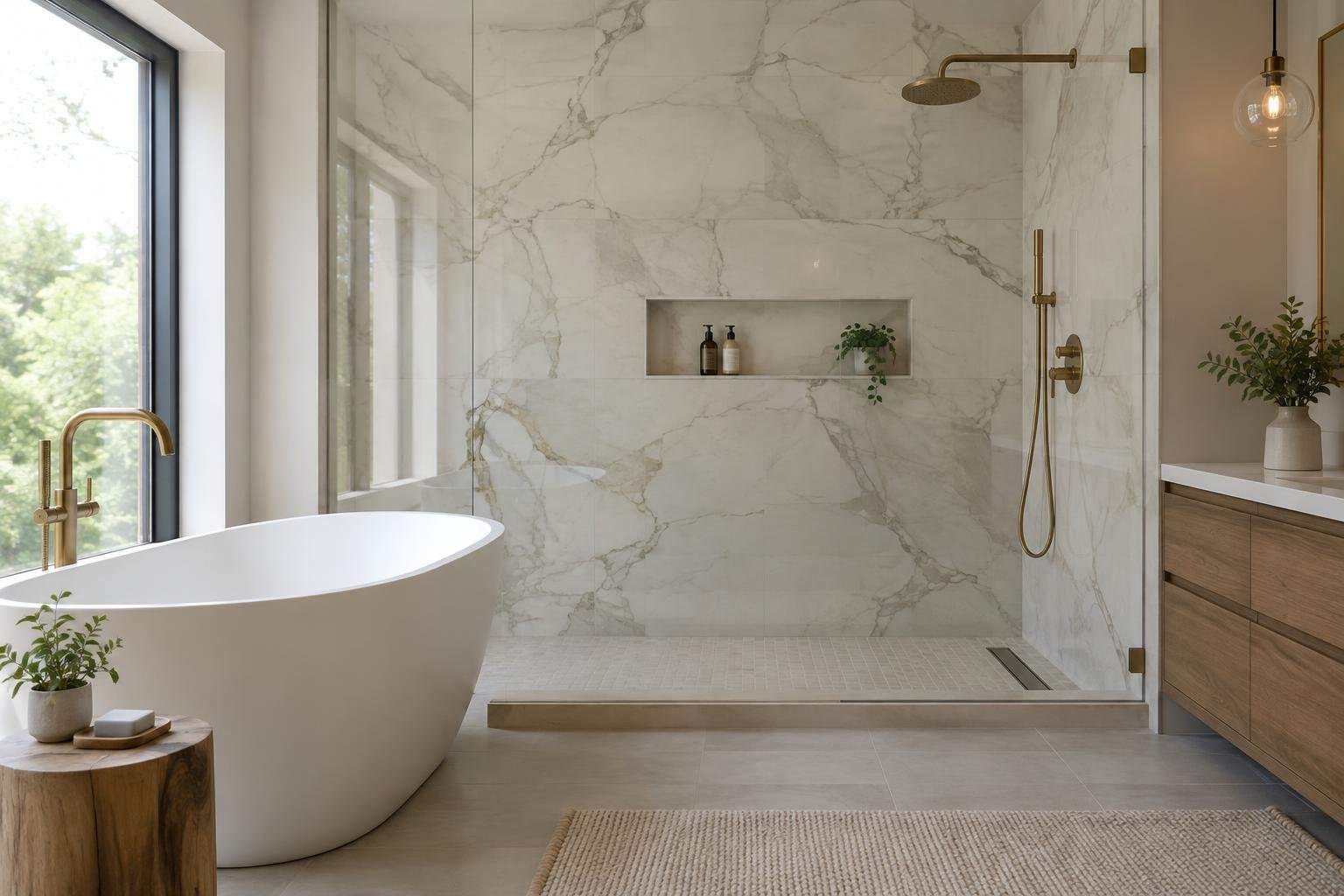
Large-format bathroom tile uses larger pieces than standard small-format mosaics or traditional small tiles. Design examples include large white tiles with subtle gray veining around an open glass shower and large square tiles arranged in a checkerboard pattern. Porcelain is another recurring option, including tile designed for shower walls and bathroom floors.
The design matters because tile covers prominent surfaces and can influence whether a bathroom feels visually calm, patterned, or highly detailed. Larger pieces can mean fewer visible joints, but they do not make a bathroom renovation simple by themselves. The product, layout, and installation plan still need to suit the room and intended surface.
What the Tile Project Includes and How to Plan It
Start by identifying which surfaces you want to tile: a bathroom floor, shower walls, a tub surround, or another wall. Then choose a product and a visual direction. For example, a restrained white tile with gray veining can keep a shower wall understated, while a large square checkerboard floor makes the pattern a central design feature. Wood-look tile offers another visual direction.
Next, review a proposed layout before materials are ordered. Discuss how it will meet corners, fixtures, openings, edges, and changes between tiled and untiled surfaces. This planning step helps you evaluate the finished composition rather than judging a loose sample alone. Ask the installer to make the intended surfaces and finish details explicit in the written scope.
Signs a Tile Update or Further Assessment May Be Needed
Large-format designs are worth considering when you want fewer visual interruptions or when small tile patterns do not match the look you want. They may also appeal if you prefer a distinctive focal point, such as veined shower walls or a graphic checkerboard floor. These are design reasons to explore a change, not evidence that existing tile is defective.
Look closely at the current bathroom before choosing a cosmetic update. Loose, cracked, or visibly damaged tile, water staining, or persistent moisture concerns call for an assessment of the underlying cause before new tile is selected.
Large-Format Bathroom Tile Cost: What to Compare
There is no dependable universal price for large-format bathroom tile installation in the available research. Costs vary with the selected product and the work included, so a generic per-square-foot number could mislead. Request written, itemized estimates based on your bathroom and chosen tile.
Ask each provider to identify materials, surface preparation, removal and disposal if applicable, installation, cuts, edge and transition finishes, and cleanup. Ask how the estimate treats unexpected conditions or changes to the agreed scope. Compare proposals only after checking that each describes substantially the same work. If you are budgeting a larger renovation, ask whether the estimate includes related work or only the tile portion.
What can affect a quote?
- Tile material, dimensions, finish, and pattern.
- How much area is tiled and which surfaces are included.
- Room layout, edges, openings, and the amount of custom cutting.
- Existing surface condition and any preparation or removal included.
- Whether the project includes other bathroom renovation work.
- Local labor, delivery, and the provider’s stated scope.
To control uncertainty, select the tile and request a site-specific estimate before ordering. Ask what is excluded and how a proposed change would be priced. The research available here does not support specific national or local project prices.
Design Options and Comparisons
Compare a few distinct design directions before narrowing the selection:
| Option | Visual effect | Useful questions |
|---|---|---|
| White tile with subtle gray veining | A restrained, continuous look for shower walls or other tiled areas. | Does the pattern suit the room, and is the exact product intended for this surface? |
| Large square checkerboard | A more graphic floor or wall feature using contrasting tiles. | How will the pattern align with walls, fixtures, and transitions? |
| Wood-look tile | A tile design that brings a wood-like visual into the bathroom. | Does the product’s finish and intended use suit the surface? |
| Porcelain with a selected finish | A broad design family that includes large-format bathroom examples. | What are the product’s use, care, and installation instructions? |
Look at samples in the room and consider how the overall pattern will read across the full surface. A small sample cannot show every variation in a larger installation. Ask the supplier what to expect from the specific product, and have the installer review the planned layout before you commit.
Tile size alone does not determine safety or suitability. Do not assume a wall tile is appropriate for a floor, or that a tile intended for a general floor is suitable for every shower-floor application. Check product documentation and ask the provider to confirm the intended use.
Pros, Tradeoffs, and Whether Large Tile Is Worth It
Large-format designs can reduce the number of visible tile joints and create a less busy appearance. A common tradeoff is that a large piece can be harder to fit visually around a room’s boundaries and interruptions. The actual result depends on the product, the room, and the layout.
Before choosing, compare the look you want with the details you are willing to manage: whether you prefer a plain or patterned surface, how noticeable grout joints should be, and how much attention you want to give to alignment at edges and transitions. Ask for a drawing or a marked-up layout when the pattern is important. A good decision is not simply “largest tile possible”; it is the tile and layout that work together in your bathroom.
What to Expect: Planning, Work, and Timing
Project timing depends on the provider’s schedule and the work included. If tile is part of a larger bathroom renovation, coordinate the tile work with other trades and materials rather than treating the tile date as the whole project schedule.
Before work begins, confirm the selected product, layout, surfaces included, preparation and removal scope, edge details, cleanup, and how changes will be approved. During the final walkthrough, compare the completed work with the written scope and ask for product care and warranty information. Do not rely on a verbal schedule or an undefined promise of completion.
How to Choose a Qualified Tile Installer
Choose a provider who can discuss both the design and the practical installation details. Ask to see relevant examples of large-format work, clarify who will perform the installation, and request a written proposal that identifies the materials and surfaces. A polished portfolio is useful, but it does not replace clear answers about your specific bathroom.
Questions to ask before hiring
- Have you installed this kind of tile and pattern in a comparable space?
- Can I see examples of your finished tile work?
- Who will perform the work at my home?
- Which surfaces and preparation tasks are included?
- What product and installation materials are specified?
- How will the layout handle corners, openings, and edges?
- What removal, disposal, and cleanup are included?
- What is excluded from this estimate?
- How will you document and price changes to the scope?
- What schedule do you expect, and what could affect it?
- What product and workmanship warranties apply?
- Who should I contact if a concern appears after completion?
Compare written proposals on scope, not just total price. Verify any license, insurance, permit, or other local requirements that apply to the work and provider in your jurisdiction.
Permits, Product Suitability, Safety, and Warranties
Requirements for bathroom work can depend on where you live and on whether the project changes plumbing, electrical systems, structure, or other regulated work. The supplied sources do not document applicable codes, licensing rules, or permit requirements for a particular location. Contact your local building department or other relevant authority before work starts, and ask the provider which approvals apply to the exact scope.
For safety, confirm that the selected product is suitable for its intended surface and follow its manufacturer instructions. Ask for the product’s care directions and written warranty terms. Clarify what coverage comes from the manufacturer and what, if anything, the installer covers as workmanship. Do not assume warranty coverage, registration requirements, or transferability without checking the actual documents.
Ways to Control Cost and Coordinate Related Projects
To manage cost without sacrificing clarity, choose the design before requesting final proposals and ask providers to quote the same surfaces and work. A straightforward pattern may be easier to compare than a proposal with unspecified decorative details, but ask the installer how each design affects the actual scope rather than assuming it will save money.
Consider whether tile belongs in a wider bathroom renovation involving a vanity, bathtub, shower enclosure, or other finishes. Coordinate decisions early so the tile design can be reviewed alongside the room’s other elements. A sample bathroom design pairs large white, subtly veined shower walls with an open glass enclosure and a freestanding bathtub; this is an inspiration example, not a required package or a promise that bundling will reduce cost.
Do not save money by skipping product checks, an appropriate assessment of existing conditions, or a clear written scope. If a quote is much lower than others, find out whether it omits preparation, finishing details, or cleanup before comparing it with competing bids.
Common Mistakes and a Practical Pre-Project Checklist
Avoid these common planning mistakes:
- Choosing tile from a small image without reviewing a sample or full layout.
- Assuming every tile works on every bathroom surface.
- Focusing on tile size while ignoring the overall pattern and room edges.
- Failing to specify the exact surfaces and finish details in the proposal.
- Comparing estimates that include different amounts of preparation or removal.
- Assuming fewer visible grout lines mean no grout or no care requirements.
- Ordering before confirming the layout and product instructions.
- Accepting a verbal schedule, scope, or warranty in place of written terms.
- Covering visible damage or moisture concerns without investigating the cause.
- Assuming a related bathroom project will automatically lower the total cost.
Before you sign: confirm product and surface suitability, review the layout, define the work in writing, check local approvals, compare equivalent estimates, and get the timeline and warranty terms in writing.
Factors That Affect the Project
Several project choices shape the design and the work to plan. First, decide which surfaces are included, such as shower walls, a tub surround, or a bathroom floor. Examples in bathroom design include white tile with subtle veining around an open shower, large square checkerboard patterns, and wood-look tile. Each creates a different visual effect and layout to consider.
The selected product and its intended use matter too. Porcelain examples include different formats for walls and floors, so confirm the exact product’s guidance for the surface you plan to tile. Finally, consider how the pattern will meet room edges, fixtures, and transitions. Reviewing these details with the installer helps clarify the project scope before materials are ordered.
Frequently asked questions
What counts as large-format bathroom tile?
Large-format bathroom tile generally refers to tile with at least one side measuring 15 inches or more, though product and trade usage can vary. Common design examples include 24-by-48-inch porcelain tile and larger square formats. Ask a tile supplier or installer to confirm the actual dimensions and whether the product suits your intended surface.
Does large-format tile make a small bathroom look bigger?
It can create a more continuous appearance because a large tile layout uses fewer individual pieces and can have fewer grout joints than a smaller-tile layout. The visual result depends on tile size, room shape, grout choice, pattern, and installation. Large pieces still need appropriate cuts around fixtures, corners, and other interruptions.
Is large-format porcelain tile a good choice for bathrooms?
Porcelain is a popular option in large-format bathroom designs, including shower walls and floors. Compare the exact product’s intended use, finish, texture, care instructions, and installation requirements before choosing. A tile shown as a wall product should not be assumed suitable for a floor or shower floor.
Does large-format bathroom tile cost more to install?
Tile material and size, surface preparation, room layout, demolition, fixture details, cuts, transitions, and the installer’s scope can all affect a quote.
Can large-format tile be used on a bathroom floor or in a shower?
Large tiles can be used on bathroom walls, shower walls, and some floors when the particular product is rated for that application and the installation plan suits the space. Ask the installer to verify product suitability, layout, drainage details where relevant, and the finish’s intended use before ordering.
How do I choose a tile installer for a bathroom renovation?
Ask for examples of comparable tile work, a written description of surface preparation and installation scope, confirmation of who will perform the work, and details about product and workmanship coverage. Also ask how the proposal handles cuts, edges, transitions, changes to the scope, cleanup, and any approvals that may apply locally.
People Also Ask
Will large bathroom tiles make a small bathroom look larger?
It can, particularly when a large, consistent tile pattern and restrained grout color reduce visual interruptions. The effect is not automatic: room proportions, tile layout, lighting, and cuts around fixtures all influence how spacious a bathroom feels. Review a layout or sample in the actual room before deciding.
What is the best large-format tile for a bathroom?
Porcelain is featured in large-format bathroom tile designs for walls and floors. Confirm that the specific tile is made for the surface where you plan to use it, then compare finish, texture, appearance, care directions, and installer requirements. Product suitability matters more than choosing by appearance alone.
Can you use large-format tile on shower walls?
Large-format tile can be used on shower walls when the selected product and installation plan are appropriate for that application. Ask the installer to explain how the design will handle corners, edges, and openings, and confirm that the full shower assembly and materials are specified in the written scope.
Does large-format tile mean less grout to clean?
Large tiles may reduce the number of grout joints compared with smaller tiles, but they do not eliminate grout or the need for appropriate installation and care. The appearance and maintenance needs depend on the product, grout, location, and manufacturer instructions. Request care guidance for the exact materials you select.
What patterns work well with large bathroom tiles?
A checkerboard arrangement using large square tiles can make a simple bathroom layout more graphic and distinctive. A quieter option is a single-color tile with a subtle pattern, such as white tile with gray veining. Consider how a pattern aligns with walls, fixtures, and transitions before finalizing the layout.
How do I estimate the cost of a large-tile bathroom renovation?
There is no dependable project price without knowing the material, amount of tile, room condition, demolition needs, layout, and labor scope. Ask for written estimates that separate tile and other materials from preparation, removal, installation, and finish details. Confirm the estimates cover the same work before comparing totals.
Large-format tile can give a bathroom a calmer, more continuous look, but the best result depends on more than tile size. Choose the material, finish, pattern, and placement together, then have the installer assess the room and explain how the design will be handled at edges, corners, and transitions. Compare written proposals that describe both the visible finish and the work behind it. When you are ready to explore your options, use Estimate.org to search for providers and compare approaches before committing.
Your next step
Explore bathroom tile options and search for providers on Estimate.org.
Last reviewed and updated October 9, 2026 by the Estimate.org Editorial Team.
Sources
- 14 Large Format Tile Bathroom Designs to Inspire Your Next Renovation
- Large-Format Shower Tile Design Ideas – Arizona Tile
- Large Format Bathroom Tile Design Inspirations
- Large Format Bathroom Wall Tiles
- r/bathrooms on Reddit: Large format tiles for bathroom
- Large Format Bathroom Tile Ideas – Arizona Tile
- 7 Beautiful Large Format Tiles for Bathroom Renovations – Procida Tile
- 15 Great Large Format Bathroom Tile Ideas – The Tile Shop Blog
