

Guest bathroom remodel cost depends less on the label “guest bath” than on the room’s size, the work included, finish choices, and local pricing. Published estimates in the supplied research range widely: one source reports $5,600 to $20,000, another gives $12,000 to $25,000, and a 2026 guide lists $8,000 to $35,000. Those figures describe different contexts and should be treated as rough reference points, not a guaranteed national price or an individual quote. A guest-bath project may update a tub or shower, toilet, sink, vanity, and finishes, but a refresh that keeps existing fixtures and layout is not the same scope as a complete renovation. Start by deciding what must change, what can stay, and whether you are willing to alter the layout. Then get comparable written estimates that spell out labor, materials, exclusions, permits, and how unexpected work will be handled. A clear scope is the most useful first step toward a realistic budget.
What a guest bathroom remodel includes
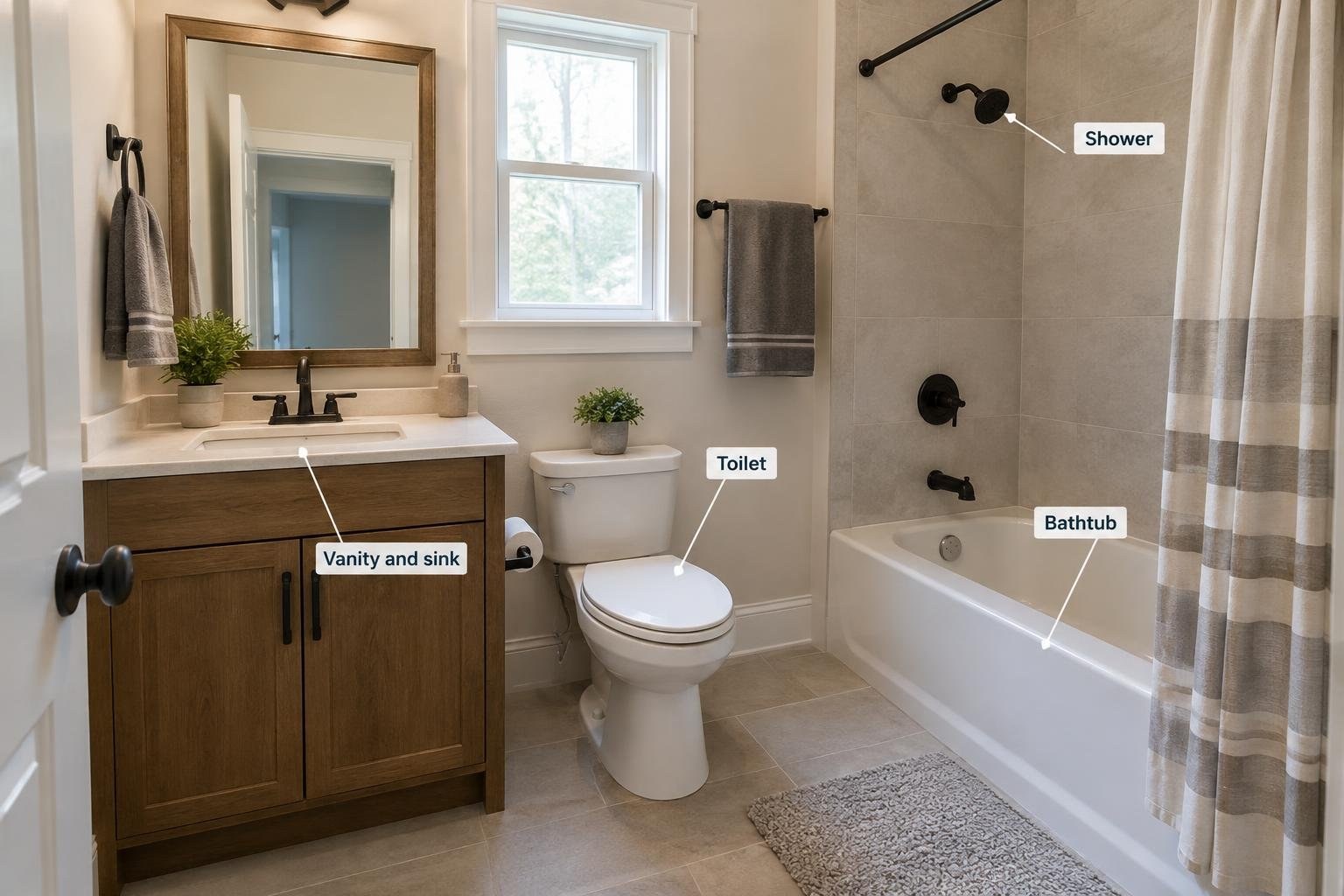
A guest bathroom renovation can mean anything from replacing a vanity and refreshing finishes to removing fixtures and rebuilding much of the room. The supplied cost sources describe projects that may include a tub or shower installation alongside toilet, sink, and vanity updates. They do not define one standard package, so the phrase “full remodel” needs a written definition before it can be priced fairly.
Begin with the purpose of the room. Is it mainly for occasional visitors, used regularly by household members, or expected to support a particular accessibility or storage need? Your answers can help distinguish essential work from upgrades. A guest bathroom may receive less daily use than a primary bathroom, but it still needs to function well for the people who use it.
Use this page to plan guest-bath costs and scope. For a broader project affecting a primary bath, see the separate full bathroom remodel cost guide. For look-and-layout inspiration rather than pricing, browse guest bathroom remodel ideas.
Guest bathroom remodel cost: what published estimates show
Project costs vary substantially in the available research. One source reports guest-bathroom renovations from $5,600 to $20,000. A Phoenix-area remodeling business gives a $12,000 to $25,000 average range. A 2026 guide lists $8,000 to $35,000 for a complete renovation, while another source reports $14,000 to $20,000 as an average. These are not a single national survey or like-for-like bids. Differences in geography, date, room size, finish level, and scope make the ranges hard to compare directly.
A separate small-bathroom guide gives $2,800 to $10,000 for many small-bath projects and describes guest baths as often 40 to 50 square feet. Another source describes an average guest bath of 80 square feet. The contrast is a reminder not to apply one assumed room size or price to your home. A separate retailer guide says bathroom remodel costs can start at $3,000, but a starting figure does not describe what a complete guest-bath renovation will cost.
Use published numbers as orientation, not a budget promise. Request local estimates for your exact room and work list, and ask each provider to identify the date and validity period of the quote. Do not multiply a generic square-foot figure by your room area unless the contractor explains what that calculation includes.
| Published example | Reported range | How to use it |
|---|---|---|
| Guest bathroom remodeling source | $5,600–$20,000 | Broad reference; verify scope and local applicability. |
| Phoenix-area contractor guide | $12,000–$25,000 | Location-specific example, not a nationwide quote. |
| 2026 complete-renovation guide | $8,000–$35,000 | Wide range tied to size and finish level in that source. |
| Small-bathroom guide | $2,800–$10,000 | Small-project context; not necessarily a full renovation. |
Factors that affect the project price
Price is shaped by the work being purchased, not just the room’s label. The supplied research directly connects bathroom cost to room size and desired upgrades, and notes that a jump in area can bring higher costs.
What can raise the estimate?
- A larger room or a broader scope that replaces more fixtures and finishes.
- More extensive upgrades or higher-priced material selections.
- Changes that add work beyond the original written scope.
- Work not included in a low base price, such as removal, disposal, or related repairs.
The last two points are estimate-checking questions, not a claim that every project will need those items. Ask the provider to state whether they are included, excluded, or billed only if required. If an issue is discovered after work starts, request a written description and price before approving added work.
What can help control the budget?
- Define must-haves and optional upgrades before requesting bids.
- Ask providers to price a base scope and any optional changes separately.
- Compare the same products or clearly stated allowances across bids.
- Consider keeping the existing layout if it meets your needs; ask for a separate price if a layout change is under consideration.
- Choose products and finishes before the estimate is finalized, or agree on how selections will affect the price.
These steps do not guarantee savings. They make estimates easier to compare and reduce the chance that a seemingly inexpensive quote omits work you expected.
Options and tradeoffs: refresh, partial remodel, or full renovation
Think of a guest-bath remodel in tiers of scope rather than as a single product. A refresh keeps most of the room and focuses on selected updates. A partial renovation replaces particular fixtures or finishes. A full renovation can involve the main fixtures and broader room updates. The supplied sources mention tub or shower installations and toilet, sink, and vanity updates as components of guest-bath projects, but do not establish a universal definition for “full.”
| Approach | Potential fit | Tradeoff to discuss |
|---|---|---|
| Refresh | Existing fixtures and layout still serve the room’s purpose. | May leave dated or poorly functioning items in place. |
| Partial remodel | One or more fixtures or finishes need attention. | New work must coordinate with items that remain. |
| Full renovation | The room needs a coordinated update across several components. | Broader scope can add decisions, cost, and disruption. |
Compare the intended use, available space, practical needs, and project-specific bids. Have providers price alternatives as distinct scopes rather than describe one as automatically better.
Likewise, compare vanity and fixture options based on fit, storage, appearance, and the work needed to install them. Ask for the exact product or a defined allowance. “Similar quality” is not specific enough to evaluate when estimates differ.
Room size, use, and material choices
Published estimates describe guest bathrooms at notably different sizes: one source cites rooms commonly around 40 to 50 square feet, another gives a typical range of 40 to 60 square feet, and another reports an 80-square-foot average. These descriptions may reflect different samples and methods. Measure your own room and share the dimensions with bidders instead of assuming your bathroom matches an industry average.
Room size alone does not tell you what the project includes. A smaller room can still involve a broad renovation, while a larger one may need only selected updates. Ask the contractor to inspect the room, confirm the proposed work, and explain whether the estimate assumes existing fixtures, plumbing locations, or finishes will remain.
Before choosing finishes, consider the room’s practical use: who uses it, what storage is needed, whether a tub matters, and whether the existing arrangement is comfortable. These are homeowner decision criteria, not a guarantee of a particular resale value or cost. If you are unsure, ask for two clearly scoped alternatives so you can compare function and price.
When to consider a remodel, and when a repair may be enough
There is no one warning sign that means every guest bathroom needs a complete remodel. Instead, list the specific problem you want to solve and ask whether it calls for a repair, a targeted update, or a wider renovation. Useful reasons to request an assessment include fixtures that no longer serve the room’s needs, finishes you intend to replace, or a plan to update several components together. These are prompts for evaluation, not diagnoses of hidden building conditions.
- Write down what does not work for the people using the room.
- Separate urgent repairs from appearance or convenience upgrades.
- Note which fixtures and finishes you want to keep, if any.
- Ask a qualified provider to inspect concerns you cannot confidently assess.
A complete renovation is not automatically the best answer to an isolated issue. Ask for a repair or partial-remodel option alongside the full scope when that is reasonable. Compare what each option addresses, what remains unchanged, and the quoted cost before making a decision.
What to expect: planning, work, and project timing
Plan to discuss the project in stages: an initial assessment, a written scope and estimate, product selection, any required approvals, the work itself, and a final review. This is a planning framework, not a guaranteed sequence or duration.
Ask each provider for a schedule that separates any planning or ordering period from on-site work. Confirm which decisions must be made before a start date, how the contractor will notify you about changes, and what events could move the completion date. A timeline should explain assumptions rather than promise a fixed finish without conditions.
Before work begins, agree on access, protection of nearby areas, removal of existing materials if applicable, debris handling, and who is responsible for coordinating workers. At the end, review the completed scope, document any open items, collect product and warranty information, and confirm the agreed cleanup. These details make expectations clearer even when the job encounters changes.
How to choose a qualified bathroom remodeling provider
Bathroom work can involve several products and types of labor, so define responsibility before signing. Ask who will manage the project, who will do each part, and who is accountable for coordinating the work. Do not treat a business’s estimate as proof that a specific individual holds a particular credential; verify any license or qualification that applies to the work with the appropriate local authority.
- What exact fixtures, materials, and tasks are included in this price?
- What is specifically excluded?
- Who will perform and supervise each part of the work?
- Will subcontractors be used, and who is responsible for their work?
- What permits or inspections may apply, and who will arrange them?
- How are changes or concealed conditions documented and priced?
- What is the payment schedule, and what milestones does it follow?
- What product, labor, or workmanship warranties apply?
- How will the work area and adjoining spaces be protected?
- Who removes debris and handles cleanup?
- What schedule assumptions could affect the start or finish?
- Can you provide references for comparable bathroom projects?
Request written answers and compare bids line by line. Check applicable insurance and licensing rather than relying only on a company’s marketing. A dependable estimate should make it possible to understand what you are buying and how changes will be handled.
Permits, credentials, safety, and warranties
Requirements for permits, inspections, and contractor credentials vary by jurisdiction and by the work planned. Ask your local building department or have the provider confirm requirements for your address and scope before work begins. Put in writing who will apply, pay fees, schedule inspections, and address any required corrections.
Review the agreement for the work description, products or allowances, total price, payment milestones, estimated schedule, change-order process, cleanup, and warranty terms. Ask for product information and the process for making a claim. A product warranty and a contractor’s labor or workmanship coverage may be separate; do not assume one covers the other. The provided research does not substantiate a standard coverage period or a universal list of exclusions.
Do not proceed with a provider who pressures you to sign before you understand the scope, offers only verbal promises, or refuses to clarify permit responsibilities. Read every term, keep copies of the agreement and changes, and confirm that all agreed work is recorded in writing.
DIY versus hiring a contractor, and red flags to avoid
A smaller project may be manageable for a reader with relevant experience, but a personal account should not be mistaken for a reliable cost benchmark. One online post describes a complete bathroom remodel that took two months and cost less than $3,000 as a DIY project, compared with a contractor quote of $6,800. It is one person’s account, not a representative estimate, and it does not establish what work or risks another project will involve.
Before deciding to do work yourself, define which tasks you can competently perform and which require a qualified professional or local approval. Budget for materials, tools, delivery, disposal, time, and the possibility that errors could require paid correction. Do not take on work that you cannot perform safely or that local rules reserve for qualified trades.
For professional bids, compare the same scope and products. Look for vague descriptions, missing exclusions, unusually low totals without explanation, pressure to pay a large amount before work is defined, cash-only demands, or refusal to put terms in writing. A low bid is not a saving if it does not cover the work you asked for.
Related projects to consider before finalizing the scope
Several nearby decisions may affect a guest-bath project. The supplied sources do not quantify savings from bundling, so evaluate convenience and cost with separate line items rather than assuming combined work is cheaper.
- Bathroom flooring: Consider it when planning a broader room update. Decide whether it belongs in the same scope as fixture and finish work; ask the provider which work should be sequenced first.
- Ventilation or related room work: If you are already considering changes beyond visible finishes, ask a qualified provider whether they should be assessed before finalizing the renovation scope. The available research does not specify technical requirements.
- Adjacent rooms or shared finishes: If a design choice affects nearby spaces, decide whether those areas are in or out of the contract. A clearly bounded scope helps prevent assumptions about extra work.
- Guest-bath design: Once you know the budget and functional priorities, explore ideas and compare alternatives without treating inspiration images as a price estimate.
Set the order based on the actual scope and advice from the providers performing the work. Ask them to explain any proposed sequence and provide a separate price for related work so you can decide whether to combine it.
Is a guest bathroom remodel worth it? Benefits, limits, and mistakes
A guest-bath remodel may be worthwhile when several parts of the room need coordinated updates or the existing arrangement no longer supports how the room is used. A repair or refresh may make more sense when the need is narrow and the remaining components are acceptable. Compare the work each option solves, the resulting scope, and written prices rather than assuming a complete renovation will pay for itself.
The sources provided do not verify a typical return on investment, energy savings, or resale premium for guest-bath remodeling. Consider benefits you can assess directly: function, the appearance you want, and whether the planned work is proportionate to your budget and expected use. If selling is part of your decision, avoid relying on a guaranteed return unless it is supported by relevant local evidence.
Common mistakes include setting a budget before defining the scope, comparing bids with different assumptions, choosing a contractor on price alone, accepting verbal changes, assuming every “full remodel” includes the same work, overlooking permit responsibility, and treating a one-person DIY story as a normal project cost. A careful written plan helps you make a more balanced choice.
Frequently asked questions
How much does a guest bathroom remodel cost?
The available estimates vary considerably because sources describe different project scopes, room sizes, locations, and pricing dates. One source gives a range of $5,600 to $20,000, another cites $12,000 to $25,000, and a 2026 estimate lists $8,000 to $35,000. Treat these as rough reference points, not a quote. Ask local providers to price the same written scope.
What is usually included in a guest bathroom remodel?
A cosmetic refresh may update paint, fixtures, or a vanity while leaving the room layout in place. A full remodel can include removal and replacement of the tub or shower, toilet, sink, vanity, finishes, and related work. The scope depends on the room and your goals, so ask each provider to spell out what is included and excluded.
How long does it take to remodel a guest bathroom?
The research available for this guide does not establish a dependable national timeline. Ask prospective providers for a project schedule that distinguishes planning and ordering from on-site construction. Have them explain how material availability, permit review, concealed damage, and changes to the agreed scope could affect the dates.
Is it cheaper to keep the same bathroom layout?
Keeping plumbing fixtures in their current locations can help limit the scope of work, but it is not automatically the right choice. Compare the cost and disruption of keeping the layout with the functional benefit of changing it. Ask the contractor to identify the specific work and price difference for each option.
Should a guest bathroom have a tub or a walk-in shower?
Not necessarily. A tub-and-shower combination may be a practical choice when you want both functions in a compact room, while a shower-only design may better suit your household's priorities. Compare how the room will be used, the space available, accessibility needs, and the written cost for each configuration before choosing.
Do I need a permit to remodel a guest bathroom?
Do not assume that a small project is exempt from local requirements. Ask the local building department or have the contractor verify whether permits or inspections apply to the planned work. Put responsibility for applications, fees, inspections, and corrections in the written agreement.
Can I remodel a guest bathroom myself to save money?
A DIY project may reduce paid labor, but the result depends on the work involved and the reader's skills. A personal online account describes one remodel taking two months and costing under $3,000, compared with a contractor quote of $6,800. That anecdote is not a typical price or guarantee. Compare a complete DIY budget, risk, and time with written professional bids.
How do I compare bathroom remodeling quotes?
Request multiple written estimates based on the same scope. Verify applicable credentials and insurance, ask who will perform and supervise the work, and compare allowances, exclusions, payment terms, permits, cleanup, and warranty coverage. A low total is not useful if it omits necessary work or relies on vague allowances.
How much should I budget for unexpected bathroom remodel costs?
There is no one reserve amount that fits every remodel. After defining the scope, decide what additional amount you can afford without exceeding your overall budget. Ask providers to explain how concealed conditions or scope changes will be priced, and require written approval before extra work begins.
Is remodeling a guest bathroom worth it?
A remodel may improve the room's function or appearance, but whether it is worthwhile depends on the condition of the bathroom, your planned use, total cost, and how long you expect to stay. Compare the complete renovation with a targeted repair or refresh, and avoid relying on an assumed resale return.
People Also Ask
What is a realistic budget for a guest bathroom remodel?
Published figures in the available research range from $5,600 to $35,000, but they are not directly comparable: sources describe differing locations, room sizes, dates, and scopes. Use them as broad context only. A local written estimate based on a defined list of work is more useful for setting your budget.
What does a full guest bathroom renovation include?
A remodel can involve a tub or shower, toilet, sink, vanity, and finish updates. The actual scope may be narrower or broader. Ask the provider to list each included item, identify work that is excluded, and explain what would count as an extra if concealed conditions are found.
Does a small guest bathroom cost less to remodel?
Compare the room's size and the specific work rather than assuming every guest bathroom costs the same. The supplied estimates include examples of guest baths around 40 to 80 square feet, but they do not establish one standard size or a price-per-square-foot formula that applies everywhere.
What parts of a bathroom remodel quote cost the most?
Require each estimate to distinguish labor, materials, removal or disposal if applicable, and allowances. This lets you compare the same scope and see whether a low price leaves important work out.
How much can DIY save on a guest bathroom remodel?
A personal online account reports spending under $3,000 on a DIY complete bathroom remodel over two months, against a contractor quote of $6,800. That is one person's experience, not a representative benchmark. Your decision should account for the exact work, tools, skills, time, and potential cost of correcting mistakes.
What should a bathroom remodeling timeline include?
Ask providers to describe the planned sequence, expected start and finish windows, ordering assumptions, and how they handle delays or changes. The sources supplied for this article do not verify a standard project duration, so request a schedule for your particular scope rather than relying on a generic promise.
A guest bathroom remodel can range from a focused refresh to a complete renovation, so a single national price is not a reliable budget. Compare written estimates for the same scope, keep the plumbing layout when practical, and decide early whether the room needs a tub, a shower, or both. Before signing, confirm who handles permits, hidden repairs, cleanup, and warranty support. When you are ready to compare approaches and providers, use Estimate.org to explore your options and make a more informed choice.
Your next step
Explore services and find providers at Estimate.org.
Reviewed and maintained by the Staff at Estimate.org.
Last reviewed and updated October 9, 2026 by the Estimate.org Editorial Team.
Sources
- What does a bathroom remodel cost in 2025 | Citizens
- How Much Does a Bathroom Remodeling Cost in 2026?
- Bathroom Remodeling Cost: What to Expect in 2026
- r/orlando on Reddit: What would be a reasonable price for a guest bathroom remodel in Orlando?
- Guest Bathroom Remodel Cost in Phoenix Arizona
- Cost To Remodel a Bathroom – The Home Depot
- How Much Does A Guest Bathroom Remodel Cost? – Home Love Construction
- Bathroom Remodel Cost 2026: Complete Guide To Pricing
