

Bathroom floor tile can set the mood for the whole room, whether you want a quiet neutral backdrop, a traditional geometric pattern, or a bold focal point. Popular design directions include penny rounds, hexagons, herringbone layouts, marble, and colorful patterned tile. The right choice depends on the look you want, how it coordinates with the shower and walls, and what the specific product and installation will cost. Design inspiration is a starting point, not a substitute for checking product specifications or getting a project-specific estimate. Before buying, compare samples in the actual room, ask how the pattern will be laid out, and get written bids with clear inclusions. That approach helps you choose a floor you like and understand the work required to achieve it.
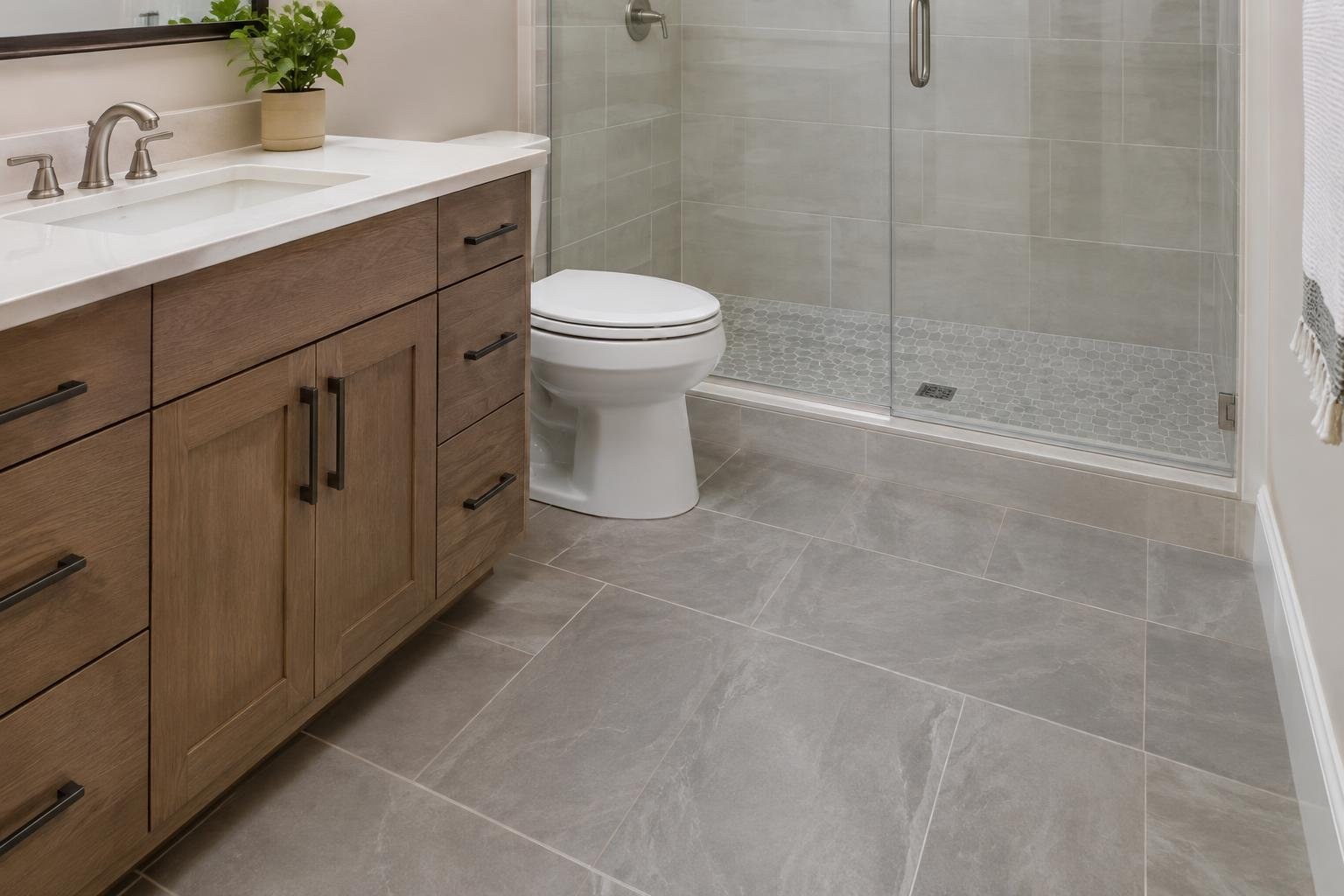
What to know before choosing bathroom floor tile
Bathroom floor tile is both a finish choice and a central part of the room’s visual composition. Design sources feature natural stone, marble, cement, wood-look plank forms, glass, porcelain, and ceramic among the options for bathroom tile. Their examples range from quiet gray-and-white layouts to elaborate mosaics and graphic patterns. These ideas can help you decide what you want the floor to contribute: color, texture, movement, or a neutral foundation.
Images do not establish whether a particular product suits every floor or wet-area application. Before choosing, check the product’s stated uses and care information and discuss the application with a qualified installer or supplier. Then get a written estimate based on the actual room and selected tile.
Decide what role the floor should play
Start by deciding whether the floor should lead the design or support other finishes. A colorful, repeating pattern can make the floor the center of attention. A neutral or monochrome choice may work better when the room already has patterned wallpaper or distinctive shower tile. Design examples show both strategies, including a geometric floor paired with patterned wallpaper and a statement floor coordinated with a glass shower.
- Focal-point floor: Choose a distinctive color, motif, or pattern, and consider keeping nearby finishes simpler.
- Supporting floor: Use a more restrained design when the walls, shower, or wallpaper already carry visual detail.
- Coordinated palette: Repeat or complement colors across the floor and other surfaces without requiring every tile to match.
These are design approaches, not rules. Use samples to judge how the combination looks in your own room.
Compare tile scale and layout
Tile scale changes the visual character of a floor. Penny rounds and other small mosaics can give a floor a detailed appearance; a designer quoted by Martha Stewart describes using penny rounds across bathroom flooring where a walk-in shower is a major feature. Larger formats can create a more expansive pattern, such as the gray-and-white herringbone floor shown in a spacious bathroom by Better Homes & Gardens.
Neither example establishes a universal rule that small tile belongs in small rooms or large tile belongs in large rooms. Ask to see the proposed layout in the actual room, including how the pattern meets edges and fixtures. Confirm that the selected product is suitable for its intended location.
Explore materials and styles without assuming performance
Choose a material and pattern together, but compare the exact products rather than relying on broad category labels. HGTV’s design guide includes options such as natural stone, marble, cement, glass, porcelain, and ceramic. Published project examples also show marble hexagons, patterned cement tile, and graphic geometric designs.
| Design direction | What it can contribute | What to confirm |
|---|---|---|
| Marble or other stone | Natural variation and a distinctive stone appearance | Product specifications, care guidance, intended use, and price |
| Cement or colorful patterned tile | A repeated motif that can make the floor a focal point | Exact product information, availability, installation scope, and care |
| Porcelain or ceramic | A broad range of visual styles and formats | Specific product’s stated application, finish, and care information |
| Small mosaic or penny round | Fine-grained pattern and a way to coordinate surfaces | Product suitability and how the pattern will be laid out |
This is a design comparison, not a performance ranking. Ask the seller or installer for product documentation before making a decision.
Pattern ideas: herringbone, geometric, and monochrome
Patterns can add movement or become the room’s strongest visual feature. Herringbone is one option for a directional look. Hexagons, Moroccan-inspired motifs, and other geometric patterns offer different levels of detail. Black-and-white combinations can create contrast while remaining a limited-color palette. Design examples also show colored patterned tile repeated across a small bathroom as a focal point.
To compare ideas, lay samples or images beside the vanity, wall finish, and shower selections. Look at the whole composition. If wallpaper or shower tile is already busy, a solid or monochrome floor may provide balance; if other surfaces are simple, a patterned floor may add interest. These combinations are illustrated in published design examples, but the best choice depends on the finishes in your own room.
Bathroom floor tile cost: what to ask estimates to include
A tile renovation may involve more than selecting a pattern. To make estimates comparable, define the room and surfaces included, identify the tile and layout you are considering, and ask each provider to state what labor and materials are covered. Do not assume two bids include the same preparation, removal, or related work. Ask for any excluded work and possible additional charges to be written down before approval.
Rather than rely on an unsupported average, request current written estimates for your specific bathroom and chosen products. A useful estimate makes the scope legible enough to compare line by line.
What affects the project price, and how to control it
The selected tile, pattern, room details, and agreed work scope can make estimates differ. A special-order or custom pattern may need different coordination from a straightforward layout; the available sources show both standard tile types and individually patterned designs, but do not document price premiums. Ask the provider to price the tile and labor for your specific selection rather than assume a cost difference.
- Ask whether removal and disposal of existing materials are included.
- Ask what preparation is included and how newly discovered work will be priced.
- Confirm whether trim, transitions, and work around fixtures are included.
- Ask whether the quote covers only the floor or also shower and wall surfaces.
- Request product names, quantities, and any separately priced materials.
To control spending safely, compare simpler and more elaborate patterns, keep the selected scope clear, and avoid changing products after work is priced without getting an updated written quote.
What to expect: planning, schedule, and project checks
Design photographs can inspire a project, but they do not reveal every detail of a particular bathroom or establish how long an installation will take. Before agreeing to work, ask the provider to explain the sequence, expected start and completion dates, access needs, and how schedule changes will be communicated. Request those details in writing.
- Choose the intended tile and pattern, then confirm product details and availability.
- Ask for a site-specific estimate with inclusions and exclusions.
- Review the proposed layout and how it meets room edges and fixed features.
- Confirm schedule, payment terms, product responsibilities, and the process for approving changes.
- At completion, review the work against the written scope and ask for product and warranty documents that apply.
Ask how the provider will protect adjacent finishes and handle cleanup. Agree on who to contact if the work differs from the approved plan.
Signs a renovation may be needed and how to scope concerns
Design ideas can help you recognize when a floor may need attention, but the supplied research does not document tile failure symptoms or diagnose their causes. If you are considering a renovation because of a damaged, loose-looking, stained, or otherwise concerning area, ask a qualified provider to inspect it before choosing a cosmetic replacement. Have the estimate state whether it addresses only the visible finish or includes investigation and repair of underlying conditions.
Do not select new tile solely to cover a problem you have not understood. Ask what the provider observed, what work is proposed, and what would happen if additional conditions are found. Get the answer and any price changes in writing.
Statement tile vs. a neutral floor
When comparing a statement floor with a neutral option, consider what else the room asks the eye to notice. A graphic pattern can be an intentional centerpiece. A restrained floor may suit a room with patterned wallpaper or detailed shower surfaces. One published example uses neutral finishes to balance patterned wallpaper, while another uses statement tile with the rest of the space kept neutral.
Likewise, choose between small and large formats by evaluating the pattern in context, not by applying a size rule. Penny rounds can coordinate a floor and shower design, while a larger herringbone layout can create movement in a spacious bathroom. For either approach, ask for a layout preview and confirm the exact product’s intended use.
How to choose a qualified tile provider
Choose a provider based on the clarity of the proposal and relevant experience, not a price alone. Ask whether the provider has completed projects with the chosen material and pattern, who will perform the work, and whether subcontractors will be involved. Request references or examples you can review, and check credentials and insurance directly with the provider and relevant local authorities where applicable.
- What exact tile, pattern, and surfaces are covered by this estimate?
- What work is excluded, and how will additional work be approved and priced?
- Who is responsible for ordering, delivery, and checking the product?
- How will the layout be reviewed before installation?
- Who will do the work, and who supervises the project?
- What is the proposed schedule and payment schedule?
- What written workmanship or product warranties apply?
- Are permits or specific local credentials required for this scope?
Compare at least two clearly itemized proposals when possible. Make sure the estimates describe the same work before comparing totals.
Permits, credentials, safety, and warranties
Licensing, permit, inspection, and insurance rules depend on the location and the work included. Ask your local building department whether the proposed scope needs a permit or inspection, and verify any required trade credentials with the relevant local authority.
Before signing, read the written scope, payment terms, change-order process, and warranty information. Ask which warranties come from the product manufacturer and which, if any, cover installation workmanship. Request applicable care instructions and product documentation. Do not treat an oral assurance as a substitute for written terms.
Ways to save without taking avoidable risks
Useful cost control comes from making decisions early and comparing equivalent proposals, not choosing a product or installer without checking the scope. Decide whether the floor is a focal point or supporting finish, narrow the material and pattern, and ask for a written layout and itemized quote. If you are weighing a simpler pattern against a custom or highly detailed design, ask providers to price both using the same room and work scope.
- Confirm product availability before finalizing the schedule.
- Ask what the estimate includes and what it excludes.
- Keep the approved tile selection and pattern documented.
- Get written approval and updated pricing for changes.
- Do not reduce cost by skipping product-use checks, required approvals, or needed investigation of a reported problem.
Related bathroom projects to evaluate together
Floor tile decisions are connected to other visible bathroom finishes. Review the floor alongside shower tile, wall finishes, wallpaper, vanity, and trim so the pattern and palette work as a whole. If a broader renovation is planned, agree which surfaces and tasks are in scope before requesting estimates. Ask providers whether coordinating work changes scheduling or price; do not assume bundling guarantees savings.
Design examples illustrate several ways to make those relationships intentional: a floor pattern balanced with wallpaper, penny rounds used to coordinate the floor and shower, and a statement floor paired with quieter surrounding finishes. Use those examples as prompts, then ask a provider to translate your room’s actual dimensions and selections into a written plan.
Common bathroom tile renovation mistakes
Common planning errors are often preventable. Avoid choosing from a photograph alone, assuming every tile in one material category has identical specifications, or expecting a pattern to look the same in every room. Do not compare bids with different scopes or treat an unspecified allowance as a confirmed product selection.
- Choosing a floor before considering the shower, walls, and other finishes.
- Assuming a design example proves a product is suitable for your application.
- Ordering before confirming product details and availability.
- Approving a pattern without reviewing the proposed layout.
- Comparing total prices without comparing what each includes.
- Relying on verbal promises about schedule, changes, or warranty.
- Skipping local checks about permits or required credentials.
- Covering a reported concern without asking what the estimate will address.
Use the checklist below to keep the design and project decisions connected.
Factors that affect the project
Project decisions start with the tile and the way it will work with the rest of the bathroom. Design examples include marble hexagons, colorful geometric and cement patterns, penny rounds, and larger herringbone layouts. The floor can be a focal point or balance patterned wallpaper and other detailed finishes.
- Material and format: Narrow down the exact product and size, then confirm its stated use and care information.
- Pattern and layout: Decide whether you want a repeating motif, a directional layout, or a quieter surface. Ask to review how the pattern meets room edges and fixed features.
- Coordination: Compare the floor with shower and wall finishes so you can settle the overall palette.
- Scope: Give each estimator the same selections and description of the work, then request a written schedule and itemized estimate.
These design choices help define what you are asking providers to plan and price. Ask them to explain how your selected tile and layout fit the specific room.
Frequently asked questions
How do I choose bathroom floor tile?
Start with the room’s overall palette and the visual role you want the floor to play. A patterned floor can become a focal point, while a more restrained floor may balance patterned wallpaper or prominent shower tile. Compare actual samples with the finishes already selected, and ask for a layout plan before ordering.
Are small tiles a good idea for a bathroom floor?
Small-scale tile can be used to create a detailed floor pattern or carry a coordinated look across a bathroom and shower, as shown in design examples featuring penny rounds. Whether a particular tile is suitable for a specific floor or shower depends on its product specifications and the project conditions, so verify those details with the supplier and installer.
Can large tiles work in a small bathroom?
Large-format tile can create a different visual effect from small mosaics. A herringbone layout using larger tiles has been used to add movement in a more spacious bathroom. Ask the installer to show how the pattern will meet the room’s edges and fixed features before the work begins.
What materials can I use for bathroom floor tile?
Marble, porcelain, ceramic, cement, glass, and natural stone appear among the bathroom tile options featured by design sources. Their appearance and product specifications differ. Compare the exact product’s care instructions, intended use, price, and availability rather than assuming that all tile in a category performs the same way.
How much does it cost to tile a bathroom floor?
There is no reliable project price without details such as the selected tile, room dimensions, pattern, labor scope, and what the estimate includes. Request itemized written estimates, and ask whether they cover preparation, removal, tile, installation, and any separate work. Compare like-for-like scopes rather than totals alone.
What tile makes a bathroom look bigger?
A pattern repeated across a small space can make the floor a strong focal point, while neutral or solid tile can help balance other decorative surfaces. Choose based on the full room, including walls, shower, vanity, and any wallpaper, rather than selecting the floor in isolation.
What should I ask a bathroom tile contractor?
Get estimates that describe the work, materials, pattern, preparation, schedule, payment terms, and how changes will be handled. Ask who will do the work, what experience they have with the selected tile and layout, and which product documents or warranties apply. Check local credential and permit requirements with the relevant authorities.
How long does bathroom floor tile installation take?
Installation time varies by project. Ask your provider for expected start and completion dates based on the selected tile, proposed layout, and agreed scope. Request the schedule in writing and ask how changes will be communicated.
People Also Ask
What is the best tile size for a bathroom floor?
Small mosaics, including penny rounds, offer a different visual scale from larger tiles and can be used to coordinate a bathroom floor with a walk-in shower design. Check product specifications and confirm with your installer that the exact tile is suitable for the intended location.
Should bathroom floor tile be light or dark?
A repeated pattern can make a small bathroom floor visually prominent, while a restrained pattern may leave more attention for other finishes. Design examples show both colorful patterned floors and neutral combinations. Consider the whole room rather than assuming one color or format will always make a space look larger.
What is a good pattern for bathroom floor tile?
A herringbone layout can add visual movement, while a grid or geometric pattern gives the floor a different character. Ask for a drawing or sample layout that shows the pattern at the room’s boundaries and around fixed features before approving the plan.
How do I coordinate bathroom floor and wall tiles?
A graphic floor can work as a focal point, especially when paired with more restrained finishes elsewhere. Design examples also show patterned wallpaper balanced with solid or monochrome tile. Select the combination as a whole so the surfaces do not compete unintentionally.
Which bathroom tile material is easiest to maintain?
The available sources show marble, porcelain, ceramic, cement, glass, and natural-stone tile as design options, but do not establish universal performance rankings. Compare the exact product’s intended uses, specifications, care guidance, and price with a qualified supplier or installer.
Are patterned bathroom floor tiles still in style?
A floor with repeating colorful patterns can become the room’s main design feature. If you prefer the floor to be quieter, use a simpler pattern and reserve visual emphasis for another surface. Look at physical samples alongside the rest of the bathroom finishes before deciding.
The strongest bathroom floor tile choice is not simply the most striking sample. It is a design that fits the room, works with the other finishes, and can be priced and installed within a clearly defined project scope. Compare full-size samples, ask how the chosen pattern will be laid out, and get written estimates that identify tile, labor, preparation, and any separate work. When you are ready, use Estimate.org to compare options and find providers to contact.
Your next step
Explore services and find providers at Estimate.org.
Reviewed and maintained by the Staff at Estimate.org.
Last reviewed and updated October 9, 2026 by the Estimate.org Editorial Team.
Sources
- 42 Bathroom Tile Ideas, from Elegant Patterns to Intricate Mosaics
- 16 Bathroom Floor Tile Ideas to Transform a Small Space
- Bathroom Floor Tile Ideas: Marble, Porcelain, Cement and More
- These Are the Most Whimsical Bathroom Tile Ideas for a Completely Unique Space
- 40 Chic Bathroom Tile Ideas | Bathroom Wall and Floor Tile Designs | HGTV
- 50 Bathroom Floor Ideas for Every Style and Budget
- 25 Charming Bathroom Flooring Ideas for 2026 | The Tile Shop
- 20 Bathroom Floor Tile Ideas That Go Beyond the Basics
