

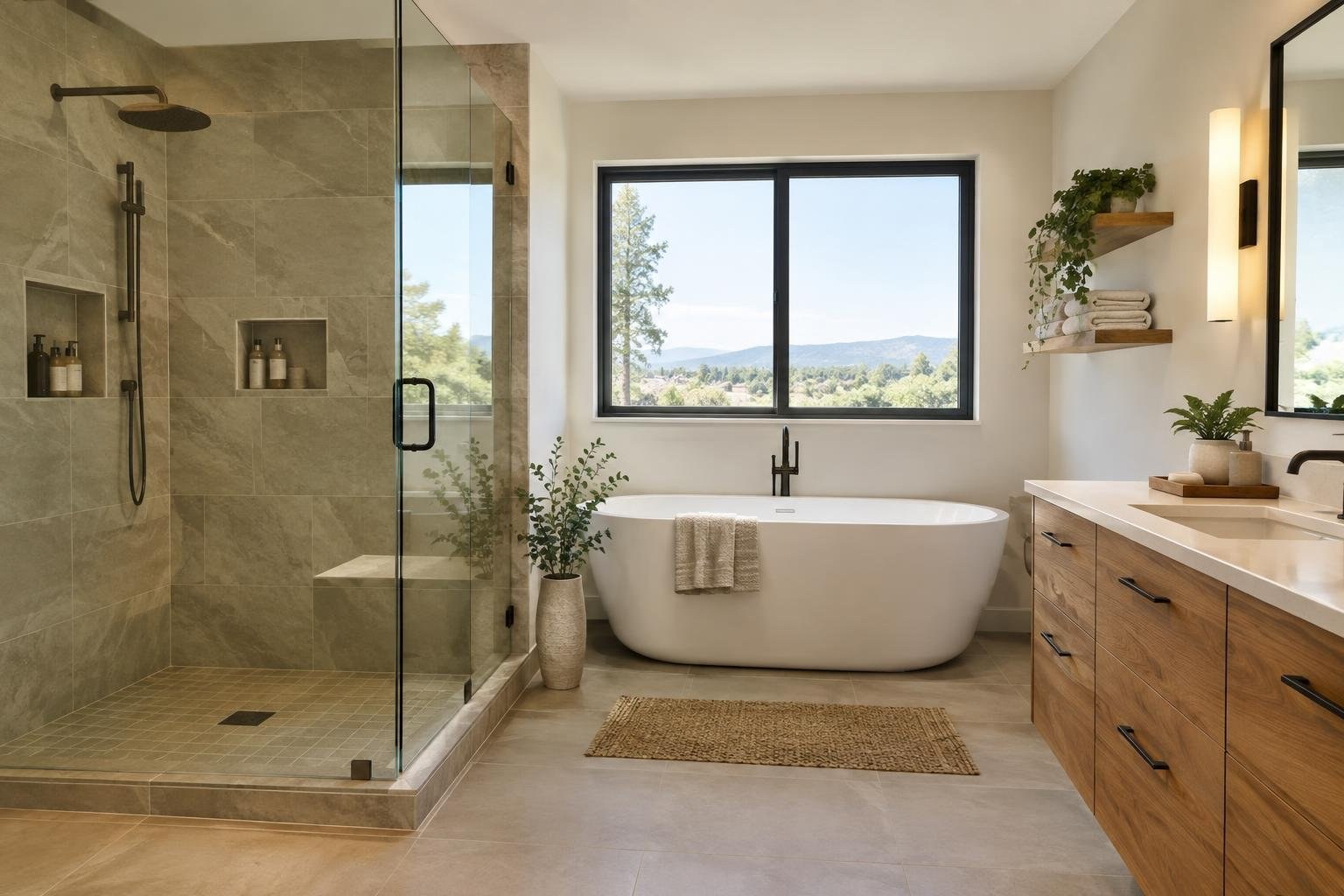
Bathroom remodeling trends for 2026 lean toward warmer finishes, nature-inspired colors and materials, more considered lighting and storage, and features intended to make the room feel comfortable and durable. These ideas can guide a full renovation or a smaller refresh, but a trend is not a project requirement. Start with what is not working in your bathroom, then decide which changes would improve daily use and which are simply decorative. Compare itemized quotes for the same scope, confirm local requirements before work begins, and choose a provider based on clear documentation as well as design appeal.
What Bathroom Remodeling Trends Mean for Homeowners
Bathroom remodeling trends are design directions that homeowners and professionals are considering, not technical standards or requirements. The 2026 coverage supplied for this guide points to warm metal finishes, nature-inspired colors and materials, improved lighting and storage, durable choices, smart technology, and spa-like comfort. Several sources also emphasize combining appearance with practical use rather than treating the room as a collection of disconnected products.
That distinction matters when deciding whether to update a bathroom. A trend can help you discover a color, fixture, or layout idea, but the project should respond to your room and routines. A cosmetic refresh may be enough if the layout and surfaces work. A broader renovation may be worth exploring if you also want to reconsider storage, lighting, or the systems that support comfort and durability.
The research package does not provide reliable local price ranges, verified product-performance comparisons, or a standard timeline. Treat any estimate as specific to its stated scope, location, products, and assumptions. Before choosing a look, list the problems you want the project to solve and the features you are willing to pay to change.
What a Bathroom Update Can Include
A bathroom remodel can involve a visual update, a change in how the room is used, or work on elements that support comfort and durability. The scope may be limited to finishes and fixtures, or it may include a more coordinated redesign. The sources describe both small updates and attention to underlying systems, but do not specify a single standard package called a bathroom remodel.
For planning, divide your wish list into three groups:
- Must solve: the practical shortcomings that prompted you to consider a project.
- Would improve: changes such as better-organized storage, a different lighting arrangement, or a finish you prefer.
- Optional: statement details or technology you would consider only if they fit the budget and project scope.
Ask providers to say explicitly which group of work their estimate addresses. A quote for a visual refresh is not directly comparable with one that includes broader renovations or system upgrades. That clarity helps prevent a design discussion from turning into mismatched expectations.
Signs It May Be Time to Revisit Your Bathroom
There is no need to remodel simply because a look is being discussed for 2026. Consider a project when the room no longer serves your preferences or when you have a defined improvement in mind. The research highlights functional as well as stylistic choices, including storage, lighting, comfort, and durability.
Before seeking estimates, write down the specific issues you notice. For example, decide whether your priority is a different visual style, more useful storage, a lighting change, or broader work on the room. Separate a preference from a problem that must be addressed. That makes it easier to decide whether a targeted update could meet your goal or whether you should explore a larger scope.
Do not assume that a fashionable finish will fix an underlying concern. Ask a qualified provider to inspect and explain any problem you believe needs repair. The sources here discuss design directions, not diagnoses of leaks, ventilation, electrical issues, or other building conditions.
Bathroom Design Options and 2026 Trends to Compare
Popular design directions in the supplied 2026 coverage can be translated into a set of choices, rather than copied as a finished look. Warmer metal finishes can be considered for fixtures. Nature-inspired colors and organic materials can inform a palette. A bold accent can add contrast, while neutral colors and familiar formats may suit readers who want a less trend-dependent design. Improved lighting and storage address practical priorities alongside appearance.
| Design direction | What to compare | Useful planning question |
|---|---|---|
| Warm finishes | How the finish relates to existing surfaces and other fixtures | Will you use it consistently or as a limited accent? |
| Nature-inspired palette | Color, texture, and how materials work together | Does the palette still appeal to you beyond a trend image? |
| Accent treatment | How much of the room it changes and what it coordinates with | Can the accent be changed without redoing the whole room? |
| Lighting and storage | Placement, everyday use, and the proposed scope | Does the change solve a specific routine or organization need? |
| Smart or spa-like features | Product details, installation needs, and warranty | Will you use the feature often enough to justify including it? |
There is no evidence in the supplied research that one finish, material, or technology is best for every bathroom. Request actual samples or product information and compare them in the context of your room. Ask providers to identify the exact products in their proposal rather than relying on broad descriptions such as “premium” or “spa-like.”
Bathroom Remodel Cost: How to Compare Quotes Without Guessing
Avoid treating an unsourced online figure as a quote for your home. Instead, compare written estimates that describe the same work and identify the products or allowances included.
Ask each provider to separate the proposed work into clear line items where possible. Confirm what is included, what is excluded, what assumptions the estimate makes, and how a change would be approved and priced. If you are considering both a small update and a larger renovation, request distinct scopes so you can judge the tradeoff instead of comparing unlike proposals.
Questions that make estimates easier to compare
- Which exact fixtures, finishes, and materials are included or assumed?
- What parts of the room are not included in the quoted work?
- Does the proposal include design or product-selection assistance?
- How will the provider document changes to the scope?
- What costs could change if the agreed work or product choices change?
- What payment schedule and warranty terms are proposed?
Do not choose an estimate by its total alone. Read the scope, compare product descriptions, and ask for clarification in writing before signing. The sources support considering both small changes and broader system-focused work, but do not provide evidence for specific savings or a particular investment return.
Factors That Affect the Project
The factors that shape a bathroom project begin with its scope. A refresh focused on fixtures, lighting, storage, or an accent wall involves different choices from a broader renovation that also considers comfort, durability, and supporting systems. The supplied trend coverage describes both smaller updates and wider project priorities, but does not define standard remodel packages or quantify how each choice affects cost.
Product and design selections also affect what needs to be included in a proposal. Warm metal finishes, nature-inspired colors and materials, smart technology, and spa-like features are among the design directions discussed for 2026. Ask providers to identify the specific products and work they have allowed for, and to explain whether a change in selection alters the scope or estimate.
Before comparing quotes, list the changes you want and separate essential improvements from optional features. Ask providers to price the same scope, state what is included and excluded, and identify any assumptions. This makes it easier to see whether a difference between estimates comes from the work proposed, the products selected, or another stated assumption.
Targeted Bathroom Refresh vs. Full Renovation
Compare a targeted refresh with a broader renovation by asking what each option changes, not by relying on a label. A refresh may focus on details such as fixtures, lighting, storage, or an accent surface. A larger project may bring more elements together and could include attention to the systems supporting comfort and durability. The sources do not define fixed boundaries between these project types, so require each provider to spell out the work.
| Decision point | Targeted update | Broader renovation |
|---|---|---|
| Best suited to | A defined visual or functional improvement while retaining much of the room | A homeowner who wants to reconsider several parts of the space together |
| Choices to examine | Finishes, lighting, storage, or an accent treatment | Design coordination, comfort, durability, and relevant systems |
| Key question | Will this solve the priority without changing more than needed? | Does each additional element serve a clear purpose? |
| Estimate comparison | Request a precisely limited scope | Request a complete list of included and excluded work |
Neither option is automatically better. Compare total scope, product descriptions, and expected disruption as described by the provider. Select the smaller project if it achieves your goals and the retained elements are suitable; consider the broader option when the additional work has a clear purpose you value.
What to Expect: Planning, Work and Timing
There is no timeline in the supplied research that can reliably predict how long a specific bathroom project will take. The schedule depends on the work and the provider’s plan. Before agreeing, ask for a written sequence that explains preparation, product decisions, work stages, any applicable inspections, and final review. Ask the provider how changes or delays will be communicated.
Plan decisions before work is scheduled. Confirm product selections, finish details, and the exact project boundary in writing. If you are considering a trend such as a bold accent, warm metal fixtures, or a smart feature, ask when that choice must be finalized and whether a substitute would change the proposal.
During the project, keep a record of approved changes and any questions about the work. At the final walkthrough, compare completed work with the written scope, ask for product and warranty documents, and write down any remaining items and how they will be resolved. Ask the provider to explain the expected process rather than assuming every remodel follows the same schedule.
How to Choose a Bathroom Remodeling Provider
Bathroom design decisions can involve multiple kinds of work. In a Houzz article about 2026 bathroom trends, the vast majority of surveyed homeowners who renovated bathrooms hired at least one professional: 89%. The article reports general contractors as the most frequently hired professionals, at 52% of projects, with bathroom remodelers and cabinetmakers each hired by 23% of renovating homeowners. Those figures describe the survey cited by that article; they are not a requirement or a guarantee that a particular provider type is right for your project.
Choose a provider whose experience and proposed scope match the work you want. Ask who will manage the project, which tasks will be performed by employees or subcontractors, and who will answer questions. Check applicable license and insurance requirements with local authorities and request documentation. Review references or examples of similar work where available, and read the written proposal before making a decision.
Questions to ask before hiring
- Which parts of my requested scope have you included?
- What is excluded or listed as an allowance?
- Who will manage the work and be my main contact?
- Who will perform each part of the project?
- What similar projects can you show or describe?
- Can you provide current proof of insurance?
- What license or registration applies to this work locally?
- Who will check whether permits or inspections are required?
- How are product selections and substitutions recorded?
- How do written change orders and added charges work?
- What schedule do you propose, and how are delays communicated?
- What cleanup and final walkthrough are included?
- Which manufacturer and workmanship warranties apply?
Compare the answers and the written scope, not only the presentation or price.
Permits, Credentials, Safety and Warranties
Permit, licensing, and inspection requirements depend on the work and the applicable local rules. The trend sources do not specify requirements for any particular city or project. Before work begins, ask the provider which requirements may apply and confirm the answer with your local building department or licensing authority. Put responsibility for applications and inspections in the written agreement.
Ask for product warranty details and the provider’s workmanship terms in writing. Identify who provides each warranty, what it covers, how long it lasts, and what the homeowner must do to make a claim. Keep product information, receipts, approved changes, and completion documents together. Do not assume that a broad verbal promise overrides the written terms.
Prioritize safety and verification over design trends. If the project raises questions about electrical, plumbing, structural, or other technical work, ask who is qualified and authorized to perform it under local rules.
Common Planning Mistakes and Provider Red Flags
Common planning mistakes include choosing a look before deciding what the project must accomplish, treating a trend as a requirement, and comparing estimates that cover different work. Other avoidable problems include accepting vague product descriptions, leaving exclusions unclear, relying on verbal change approvals, or assuming a warranty covers every part of the project.
- Do not select finishes from an image alone; check the actual products and how they coordinate.
- Do not add smart or spa-like features without understanding their product requirements and terms.
- Do not assume a small refresh and a full renovation are comparable quotes.
- Do not accept an estimate without a clear scope and stated exclusions.
- Do not rely on an unverified claim about local credentials or permits.
- Do not sign before clarifying who handles changes, cleanup, and final review.
- Do not assume a trend will suit your preferences for the long term.
A warning sign in the proposal is any unresolved mismatch between the work you discussed and the work described on paper. Pause and request clarification before signing. If a provider will not explain the scope, credentials, or warranty terms, compare another qualified option.
Related Bathroom Decisions to Coordinate
Bathroom design choices work best when coordinated. If your project includes multiple surfaces, fixtures, lighting, storage, or system decisions, ask the provider to explain how those pieces fit together and which selections need to be made first. The supplied sources discuss bathrooms as complete environments and also describe smaller, standalone updates; they do not prescribe a universal order for coordinating work.
Before bundling related decisions, ask whether they share a project scope, affect one another, or can be handled independently. Confirm which provider is responsible for each item and whether changing one choice affects the rest of the estimate. Do not assume that combining services automatically reduces price or disruption. If a change involves another trade or a separate technical system, clarify who coordinates it and whether local requirements apply.
For a smaller refresh, you may be able to focus on lighting, storage, or fixtures without revisiting every finish. For a more extensive design, ask for a coordinated selection plan so you can review the palette and products together before authorizing work.
Is a Bathroom Remodel Worth It?
Bathroom trends are useful when they help you ask better questions. The 2026 coverage points toward balancing personal style with practical function, including attention to lighting, storage, materials, comfort, and durability. But the research does not show that remodeling guarantees a resale gain, lower operating costs, or a particular financial return. Treat those outcomes as unproven unless you have reliable evidence specific to your decision.
A project may be worthwhile if the proposed changes address needs you value and the written estimate fits your budget. A smaller update may be the more sensible choice when it accomplishes your priorities without a full redesign. A broader renovation may make sense when the added work has a clear purpose and you understand its scope, requirements, and warranty terms. Decide based on use, product choices, budget, and plans for the home, not on claims that a particular 2026 look is universally best.
Frequently asked questions
Should I remodel my bathroom just to follow 2026 trends?
No. Trends are a source of ideas, not a reason to replace a bathroom that works for you. If the layout, surfaces, or fixtures no longer meet your needs, use current design directions to compare possible updates. Choose changes that suit your routine and budget, and avoid making a lasting decision based only on a short-lived look.
What bathroom design trends are highlighted for 2026?
The supplied trend coverage highlights warmer metal finishes, nature-inspired colors and materials, improved lighting, storage, bold accent treatments, and comfort-focused features. These are design directions rather than rules. Consider them alongside your bathroom’s existing finishes, your preferences, and how much change you actually want.
Can I update a bathroom without a full remodel?
A small update can be enough if the bathroom functions well and you want a visual refresh. Potential design changes include new fixtures, improved lighting, added storage, or an accent treatment. Compare the scope of those changes with a full renovation, and get a clear written description of any work before hiring someone.
How much does a bathroom remodel cost in 2026?
Request itemized estimates based on the same scope, including the products, labor, and any work proposed beyond visible finishes. Ask each provider how changes to the scope would be documented and priced before work starts.
What should I decide before asking for bathroom remodeling estimates?
The scope and choices matter more than a trend label. Before requesting estimates, write down what you want to change, what should stay, and which finishes or features are priorities. Ask providers to describe the same project so you can compare their proposed work and products clearly.
How do I choose a bathroom remodeling contractor?
Ask providers about relevant project experience, who will perform the work, what is included in the written scope, how changes are handled, and which local permits or inspections may apply. Verify licensing and insurance requirements with the appropriate local agencies, and get product and workmanship warranty terms in writing.
Which bathroom features are worth prioritizing in a remodel?
A bathroom can benefit from more than a fashionable fixture or finish. Consider whether lighting, storage, and the systems supporting comfort and durability fit your needs. The available trend coverage discusses attention to core systems, but it does not establish that every bathroom needs those systems upgraded.
Are smart or spa-like bathroom features worth the extra cost?
They can, depending on the products and work involved. Before choosing a feature, ask the provider what it requires to install, how it will be operated and maintained, and what warranty applies. The available trend sources identify smart technology and spa-like features as design interests, but do not verify product performance or savings.
People Also Ask
Do I need a full bathroom renovation to follow 2026 trends?
Not necessarily. A smaller update may suit a bathroom that functions well but needs a visual refresh. Consider changing fixtures, lighting, storage, or an accent treatment before deciding that a full renovation is needed. Ask providers to define and price each scope separately so you can compare options.
What are the biggest bathroom remodeling trends for 2026?
The 2026 trend sources mention warmer metal finishes, nature-inspired palettes and materials, improved lighting, storage, bold accents, smart technology, and spa-like comfort. Treat these as ideas to evaluate rather than a universal design prescription.
What is a reasonable budget for a bathroom remodel in 2026?
The sources available for this guide do not provide current, location-specific pricing. The most useful next step is to describe the same work and product expectations to multiple providers, then compare itemized estimates and ask what is excluded.
How do I plan a bathroom remodel before contacting contractors?
Decide which problems the project should solve, what you want to keep, and which design choices matter most. Gather inspiration, but wait to commit to products until you have checked dimensions, scope, and the provider’s written proposal.
What questions should I ask a bathroom remodeling contractor?
Ask about similar work, written scope, project supervision, subcontractors, local permits, insurance, change orders, cleanup, and warranty terms. Verify any required license or registration with the relevant local agency before signing.
How long does a bathroom remodel take?
Ask each provider for a written schedule covering planning, product availability, site work, inspections if applicable, and final review. Have the provider explain how delays or changes would be communicated.
Are smart bathroom features a good investment?
The available sources identify smart technology and spa-like features as design interests, but do not establish that they save money or improve every bathroom. Evaluate the specific product, installation needs, operating instructions, maintenance, and warranty before deciding.
Bathroom remodeling trends for 2026 offer ideas, not a checklist. The most useful choices are the ones that solve a real problem in your bathroom, fit the way you use it, and make sense for your budget and plans for the home. Decide what matters most, compare products and written project scopes, and verify local requirements before work begins. When you are ready, compare your options and search for providers on Estimate.org.
Your next step
Explore services and find providers at Estimate.org.
Reviewed and maintained by the Staff at Estimate.org.
Last reviewed and updated October 9, 2026 by the Estimate.org Editorial Team.
Sources
- 5 Bathroom Remodeling Trends to Know in 2026
- 2026 Bathroom Design Trends: Ideas to Transform Your Space
- 2026 Bathroom Ideas and Trends You'll Want to Copy – Modern Bathroom
- Top Bathroom Remodeling Trends for 2026
- 15 Home Design Trends Driving Bathroom Renovations In 2026
- Bathroom Design Ideas: Top 8 Renovation Trends in 2026
- Bathroom Trends 2026: What’s In, What’s Out, and What’s Next
- 2026 Bathroom Design & Remodel Trends with Jenny Marrs
