

Bathroom tile affects the room’s overall look, from a quiet, continuous stone-inspired scheme to a bold patterned floor or a full-height tiled wall. The most useful bathroom tile ideas for a renovation do more than look attractive in a photo: they help you decide which surfaces to emphasize, how colors and patterns work together, and what to clarify before installation. Start by identifying the areas you want tiled, then choose a palette, tile scale, and layout that fit the style you want. Compare physical samples in the bathroom, where light and nearby finishes can change how a color reads. Ideas featured by designers and tile retailers include subway layouts, herringbone, geometric patterns, terra-cotta looks, mosaics, and floor-to-ceiling tile. Current, location-specific project prices are not established by the available design research, so get comparable written estimates for your own scope rather than relying on a generic per-room figure.
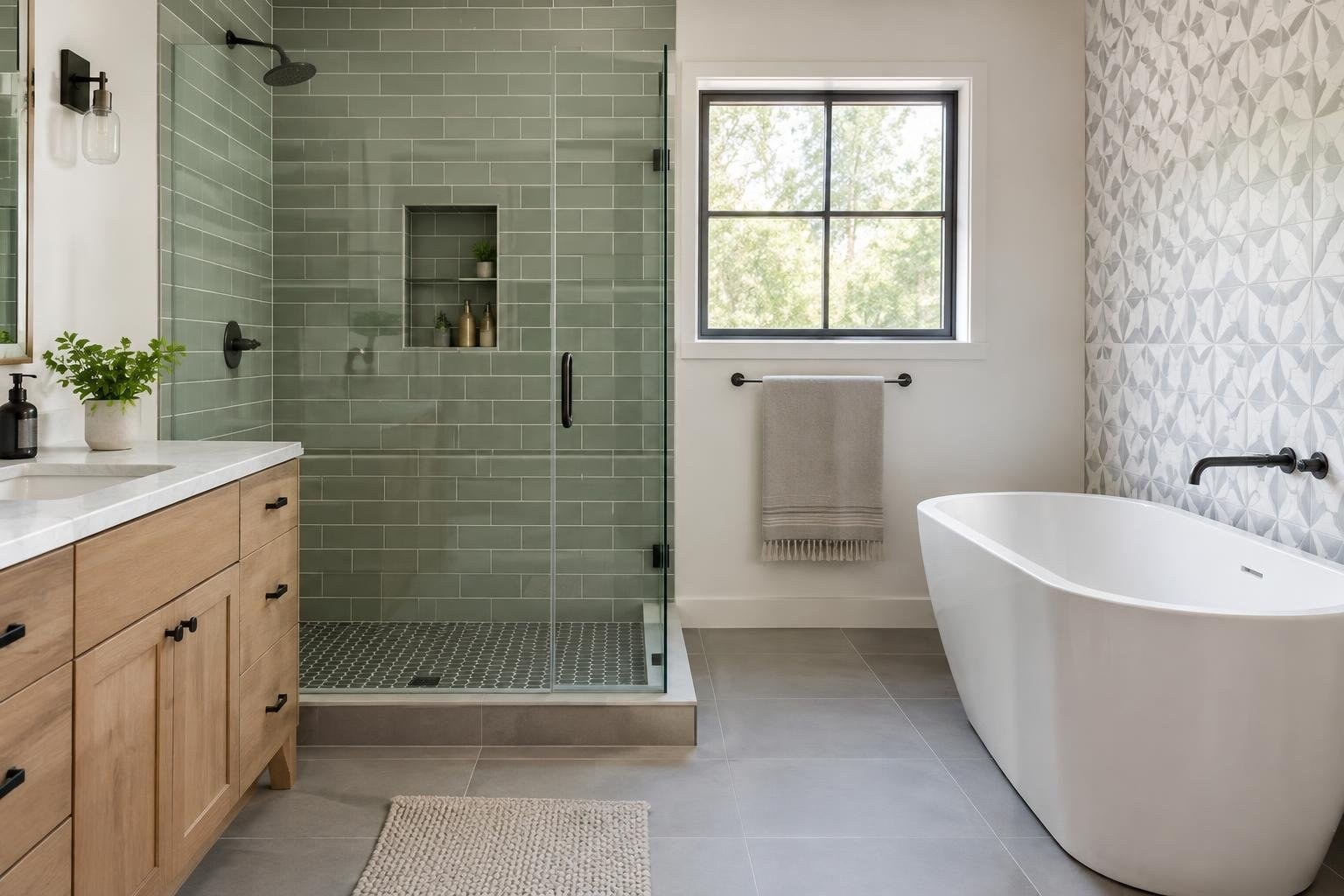
What bathroom tile ideas can change in a renovation
Bathroom tile is a surface finish used on floors, walls, shower areas, backsplashes, and other selected parts of a bathroom. In a renovation, it can refresh the room’s appearance or help establish its overall style. Tile choices involve more than color: the pattern, shape, scale, material look, and arrangement all influence the finished scheme.
Tile inspiration ranges from simple subway layouts to bold geometric designs, mosaics, terra-cotta looks, and tile that continues from floor to ceiling. A coordinated stone look across walls and floors is another way to reduce the number of competing visual elements. Begin by deciding which surfaces are part of the project and what you want people to notice first.
Keep the design goal practical: select a scheme you will be comfortable seeing every day, and confirm the actual products and layout before ordering. Inspiration images are useful starting points, not a substitute for checking samples and project details.
How to plan tile across floors, walls, and accents
Think of a tiled bathroom as a composition of surfaces. The floor, wall field, shower area, and smaller accents can share a material or palette, or they can contrast. A full-height wall treatment creates a continuous visual plane; a limited backsplash or patterned section creates a more contained point of interest.
Before choosing a pattern, map the surfaces being changed and note how each meets a doorway, fixture, or adjacent finish. Then decide whether the room needs one dominant feature or several quieter elements. This order makes it easier to compare options without getting stuck choosing individual tiles one at a time.
For a restrained design, consider repeating one material look across multiple surfaces. For a more expressive room, let one pattern or color lead and keep other selections connected to it. Tile designers show both approaches, from unified stone-inspired schemes to playful geometric and historic-home patterns.
Bathroom tile patterns and styles to consider
- Subway layouts: A familiar tile shape can be arranged in a straightforward or more distinctive layout. Consider how the pattern will meet corners and edges.
- Herringbone: An angled arrangement can make a simple tile look more dynamic. Terra-cotta-look tile in a herringbone pattern is one design example.
- Geometric and patterned tile: Strong shapes or colors can provide a focal point, especially in a room with simpler surrounding finishes.
- Mosaics: Small-format pieces can introduce detailed pattern or color. Decide where the detail belongs so it supports rather than competes with the rest of the room.
- Monochrome: Black-and-white schemes use contrast for a graphic effect.
- Full-height tile: Carrying tile from floor to ceiling creates a more continuous wall treatment.
- Terrazzo-inspired looks: Ceramic and porcelain options can provide a terrazzo-style appearance.
These are design directions, not prescriptions. Compare the pattern, finish, and color as a complete scheme before settling on one.
Compare a unified tile scheme with mixed finishes
Tile size is only one part of how a room reads. A single stone-inspired surface across walls and floors can create a unified impression; mixing sizes and finishes can add layers and variation. Neither approach is automatically right for every bathroom. The key is to decide how much visual detail you want and whether it supports the room’s overall style.
| Design approach | Visual effect | Consider it when |
|---|---|---|
| One coordinated material look | Fewer competing finishes and a more continuous scheme | You want a restrained, cohesive room |
| Mixed sizes or finishes | More variation and layered interest | You want the surfaces to have distinct roles |
| Bold pattern or color | A noticeable focal point | You want tile to define the room’s character |
| Tile from floor to ceiling | A continuous wall treatment | You want the wall finish to read as one plane |
Use samples or a planned layout to compare options. A pattern that looks appealing in a photograph may feel different when repeated across your own floor or walls.
Material, color, and finish: how to make a coherent selection
Tile appearance and material are related, but not interchangeable. Design coverage describes terrazzo-style looks in ceramic and porcelain tile and features stone-inspired and terra-cotta designs. When comparing products, confirm the actual material and finish rather than relying on a pattern name or photograph.
Bring together the tile, grout color, and nearby finishes in a sample board or other side-by-side review. Check the selection in the bathroom and consider it next to the fixtures and colors that will remain. If you are combining multiple patterns, choose a lead element first, then select supporting surfaces that do not pull the eye in several directions.
Ask the provider to identify the products in the written proposal, including the intended locations and layout. That makes it easier to confirm that the tile being priced is the tile you selected.
Factors that affect the project
A useful bathroom tile estimate should be based on the defined project scope rather than a generic figure. Ask providers to identify the chosen tile, surfaces included, installation work, and any other items they have included or excluded.
Compare estimates using the same assumptions: the same room areas, product selections, layout, and project boundaries. If one proposal covers more work than another, the totals are not directly comparable. Ask what could change the price once work begins and how changes will be approved.
What can affect a tile project estimate?
- Which walls, floor areas, or accents are included
- The selected tile and pattern
- How much layout detail and coordination the design calls for
- Whether the proposal includes removal, preparation, or related renovation work
- How the installer treats edges, corners, and transitions
For a useful budget, request an itemized estimate and keep a record of product selections and scope changes. Do not assume that a low total includes every part of the work.
When should you consider changing bathroom tile?
Before deciding whether new tile is needed, identify what prompted the project. You may want a different appearance, a more coordinated palette, a new pattern, or a more extensive bathroom renovation. Inspiration alone does not establish whether existing tile has a functional problem, so assess the condition and scope separately from the design decision.
If your goal is mainly visual, compare the proposed tile change with other ways to update the room and identify which surfaces most affect the result. If the work is part of a larger renovation, clarify which related work is included before selecting tile. A plan that treats only the visible finish may not match a project that changes several parts of the room.
Write down the reason for the project and the outcome you want. This gives you a practical test for each design choice and helps providers respond to the same brief.
What to expect from a bathroom tile project
Before scheduling, ask what stages are included, when you need to select or approve products, and what decisions could affect the schedule.
- Set the scope: Identify the surfaces and any related renovation work.
- Choose the design: Select tile, color, pattern, and layout.
- Confirm the proposal: Check the product names, included areas, price assumptions, and exclusions.
- Coordinate the work: Agree on the planned sequence, access, and decision points.
- Review the result: Walk through the completed work against the written scope and clarify product or workmanship warranty details.
Ask for a written schedule rather than assuming that a tile-only project and a broader bathroom renovation will take the same amount of time. Confirm how the provider will communicate changes to the plan.
How to choose a bathroom tile provider
Design inspiration cannot verify a contractor’s qualifications. Before hiring, check the applicable local requirements and ask prospective providers for relevant experience, references, proof of insurance, and a written scope. Confirm who is responsible for product selection, layout approval, project coordination, and any required permits.
Ask each provider to show how the proposed pattern will meet edges and transitions, and to list the tile and surfaces in the estimate. Clarify the schedule, payment milestones, how changes are documented, and what warranty applies to products and workmanship. Request references for work that resembles the scale or design complexity of your project.
Questions to ask a tile provider
- Which surfaces and tasks are included in this estimate?
- What tile products and layout are you proposing?
- Can I review the planned pattern and edge details before work starts?
- Who obtains any permits required for this scope?
- What licensing or insurance requirements apply locally?
- How will changes to scope or price be approved?
- What product and workmanship warranties apply?
Permits, credentials, warranties, and project safety
Permits, licensing, and other rules depend on the work and local jurisdiction. Ask the local building department or relevant licensing authority what applies to your project, especially if tile is part of a wider renovation. Do not assume a tile design article can establish code requirements for your address.
Get the provider’s responsibilities in writing, including whether they will handle required permits and inspections. Confirm which products are covered by manufacturer terms and which parts of the work are covered by a workmanship warranty. Request the warranty documents, understand any registration or maintenance conditions stated there, and keep product and project records.
Review the proposed work and work area with the provider before the project begins. For questions about safety or technical requirements, rely on qualified local professionals and the applicable authorities rather than design inspiration alone.
How to manage the budget without compromising the plan
Cost-conscious planning begins with a clear design, not an automatic move to the cheapest tile. Compare multiple written proposals based on the same scope and product assumptions. Ask whether a simpler layout or a more limited accent area could achieve the look you want, and find out how each option changes the proposal.
Choose tile and patterns deliberately before ordering. A coordinated palette can reduce indecision, while deciding in advance which area will be the focal point can help prevent unnecessary additions. Do not remove work from the scope without understanding what it covers, and do not make a product substitution without confirming that the written estimate and final selection still match.
Useful savings are transparent: understand the complete scope, avoid unapproved changes, and compare like with like. Treat a substantially different proposal as a reason to ask questions, not as proof that it is the better value.
Common bathroom tile renovation mistakes
- Choosing from a photo alone: Review a physical sample in the bathroom before committing.
- Starting with too many competing ideas: Pick a focal point, then coordinate supporting surfaces.
- Ignoring layout: Agree on pattern, direction, and visible transitions before work begins.
- Assuming one tile fits every surface: Confirm the selected product and intended location with the provider.
- Comparing totals without comparing scope: Check included work, products, and exclusions.
- Leaving details until installation: Confirm product choices and layout in advance.
- Skipping written terms: Record schedule, payment, change approvals, permits, and warranty responsibilities.
- Choosing only on the lowest bid: Ask what the estimate includes and whether the provider’s qualifications and references check out.
A clear plan helps you evaluate design and proposals together. Keep the approved selection and scope available throughout the project.
Related bathroom projects to coordinate with tile
Bathroom tile decisions may overlap with a wider renovation. Consider adjacent surfaces, fixtures, and other finish selections while defining the scope, so the tile design does not conflict with work planned elsewhere.
- Bathroom floor tile: Evaluate it with the wall palette and room-wide layout. Decide which finish leads before finalizing both.
- Bathroom wall tile: Consider height, pattern, and how the wall treatment ends at edges. Set its role before choosing an accent.
- Vanity backsplash: Coordinate it with the vanity and any larger wall-tile scheme. Decide whether it should blend in or act as a focal detail.
- Broader bathroom renovation: Establish which work is included before selecting tile. Ask providers how they coordinate the tile scope with other planned work.
Ask for separate scope and price details so you can compare the combined proposal with the individual work.
Is a bathroom tile renovation worth it?
Bathroom tile can be worth considering when it supports a renovation goal you can clearly describe, such as bringing the room’s surfaces into a more cohesive scheme or adding a pattern that gives the space character. A full-height tile treatment, a unified stone-inspired palette, and a bold patterned floor offer different ways to shape the room.
The tradeoff is that an appealing design still needs a clear scope, product selection, and installation plan. Decide how much change you want, compare options against the surfaces that will remain, and get written estimates before making a commitment. Do not assume that an inspiration image or a general project claim predicts cost, schedule, or resale value for your home.
If you are unsure, compare a restrained update with a more extensive redesign and ask providers to quote each option separately. Choose the approach that fits your priorities and budget.
Frequently asked questions
How do I choose tile for a bathroom renovation?
Start with the room’s use, the surfaces being tiled, and the look you want to create. Consider color, pattern, tile scale, and how finishes relate to one another. For a cohesive scheme, repeat a color or material in more than one area, then review physical samples in the bathroom before choosing.
Are large or small tiles better for a bathroom?
A large tile can create a calmer, less segmented appearance, while smaller tiles and mosaics can introduce detail or pattern. The right choice depends on the design, the surface, and how you want the finished room to feel. Compare samples and planned layouts rather than relying on a tile’s appearance in a small online image.
Should bathroom walls and floors use the same tile?
A single stone look across walls and floors can simplify the visual scheme. Using more than one tile can add contrast and define areas, but it takes care to coordinate color, scale, and finish. Decide which surface should be the focal point, then use the other tile choices to support it.
What are popular bathroom tile patterns?
Tile design articles feature options such as subway layouts, herringbone, geometric patterns, mosaics, monochrome schemes, and terra-cotta looks. Choose a pattern based on the room’s overall style and how much visual attention you want the surface to receive. A sample board or full-size layout can help you judge the effect.
Should bathroom tile go all the way to the ceiling?
Yes. Full-height tile can create a continuous look from floor to ceiling, while a tiled backsplash or a single accent area can add a more focused detail. Decide how much of the room should carry the pattern or material, and ask the installer to show where tile edges and transitions will fall.
How much does a bathroom tile renovation cost?
The estimate depends on the selected tile, the surfaces included, the layout, and whether the proposal covers related work such as removal or preparation. Ask providers for itemized written estimates based on the same project scope and product selections, then compare what each includes.
How do I find a qualified bathroom tile installer?
Look for providers with relevant bathroom tile experience, check references and reviews, and verify licensing and insurance requirements with the appropriate local authorities. Ask for a written scope, proposed layout, product details, schedule, payment terms, and warranty information. Confirm who handles permits if the project requires them in your jurisdiction.
What should I decide before ordering bathroom tile?
Before ordering, confirm the quantity, pattern, orientation, transitions, and where cuts will appear. Review the actual tile sample in the bathroom and check that the written project scope describes the same products and surfaces you expect. Clarifying those choices early can help prevent design misunderstandings during the work.
People Also Ask
How can I make my bathroom tile look more interesting?
A patterned floor, a colorful geometric feature, a vanity backsplash, or a coordinated tile palette can each make a bathroom feel more distinctive. Keep the rest of the scheme in conversation with the feature so the room feels intentional. Consider a single stone look across walls and floors if you prefer fewer competing materials.
What tile ideas work in a small bathroom?
For a small bathroom, a consistent tile across several surfaces can make the scheme feel less interrupted. Alternatively, a focused accent or reflective tile can add a different effect. Review sample sizes and layout in the actual room rather than assuming one tile size or color will work in every small space.
What bathroom tile patterns add character?
A herringbone layout can give terra-cotta-look tile a more graphic arrangement, while geometric or bold-color patterns create a stronger focal point. Use samples or a layout mock-up to assess the pattern alongside the room’s other surfaces before making a final selection.
What does tile-to-the-top mean in a bathroom?
Tile-to-the-top designs carry the wall finish up to the ceiling for a continuous appearance. This can be paired with one tile throughout or with varied sizes and finishes. Decide how the top edge, corners, and transitions will look, and include those details in the installer’s proposed layout.
Can I get a terrazzo look with bathroom tile?
Yes. Terrazzo-inspired looks are available in ceramic and porcelain tile, according to tile design coverage. Compare the specific product, color, and finish you are considering, and review a sample in the room. A pattern that resembles terrazzo can offer a distinct look without selecting a natural terrazzo surface.
How do I use black-and-white tile in a bathroom?
A monochrome scheme pairs black and white for a strong, graphic contrast. It can be used in a pattern or balanced with simpler surfaces elsewhere in the room. Review the layout and grout choice together, since both contribute to the overall appearance.
The best bathroom tile idea is one that suits the room, feels right to live with, and can be installed as a coherent design. Start with the areas you want to change, choose a palette and pattern, then check samples in your bathroom’s light before committing. Compare complete written proposals, including the planned layout and project scope, and look for qualified providers on Estimate.org.
Your next step
Explore services and find providers at Estimate.org.
Reviewed and maintained by the Staff at Estimate.org.
Last reviewed and updated October 9, 2026 by the Estimate.org Editorial Team.
Sources
- 37 Beautiful Bathroom Tile Designs for 2025 – Mercury Mosaics
- 23 Bathroom Tile Ideas: Patterns, Layouts, and Real Project Photos | Ranney Blair Weidmann
- These Are the Most Whimsical Bathroom Tile Ideas for a Completely Unique Space
- 47 Bathroom Tile Ideas To Inspire Your Renovation
- 10 Small Bathroom Tile Design Ideas
- 36 Beautiful Bathroom Tile Ideas for 2026 | The Tile Shop
- 15 Stunning Bathroom Tile Ideas for a Functional and Stylish Space — THREE BIRDS RENOVATIONS
- 42 Bathroom Tile Ideas, from Elegant Patterns to Intricate Mosaics
