
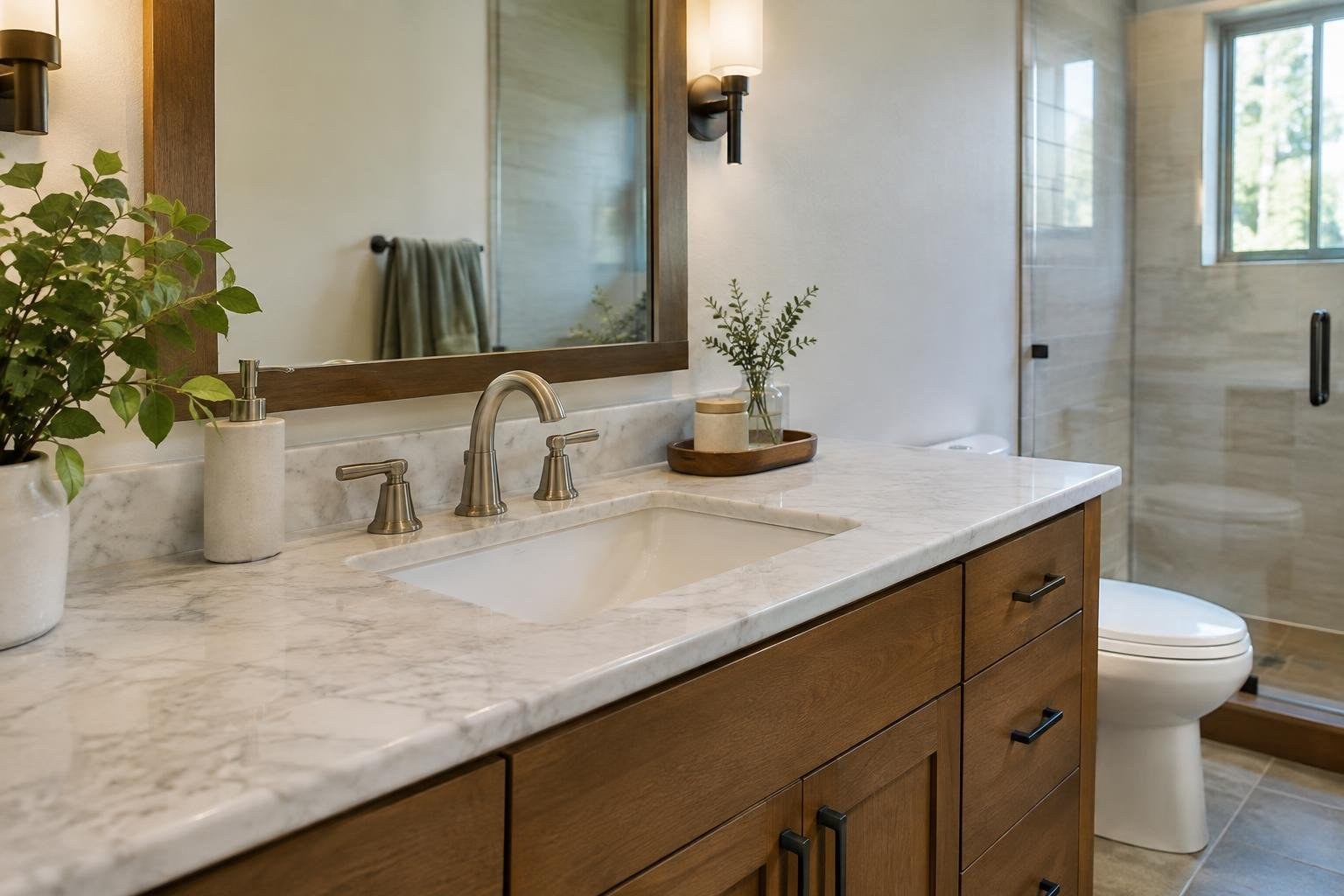
Bathroom countertops have to work in a room that sees regular water, humidity, soaps, and cosmetics. The best material for your renovation depends on how much maintenance you want, the look you prefer, your budget, and the conditions in the bathroom. Quartz, granite, and porcelain slabs are commonly considered for durability and moisture resistance; laminate and cultured marble are described as more affordable alternatives. Marble offers distinctive natural veining, while wood and recycled-content surfaces can suit more specific design or sustainability preferences. There is no universal winner. Compare actual samples, check product-specific care instructions, and request a written quote that spells out what is included before you order. A countertop’s fit and finish matter, but so do the sink, faucet, vanity, and any related work that may affect the project.
What to know about bathroom countertops
A bathroom countertop is the work surface fitted over or integrated with a vanity. It supports the sink and faucet, provides a place for everyday items, and contributes substantially to the room’s appearance. Replacing one may be a small standalone update or part of a larger bathroom renovation.
Unlike a dry display surface, a bathroom counter regularly encounters water, humidity, soaps, and cosmetics. Material selection should account for those conditions as well as appearance, price, and upkeep. The sources for this guide describe quartz, granite, and porcelain slabs as options often selected for durability and moisture resistance, while laminate and cultured marble are affordable alternatives with different limitations.
Start by deciding what matters most: a particular look, lower initial cost, simpler care, or a distinctive natural material. Then compare actual products and clarify the installation scope. A material label alone cannot tell you how a specific finish should be cleaned or what the full project will cost.
What a countertop project includes
Countertop projects can include more than selecting a surface. Depending on the scope, the work may involve measuring the vanity, choosing an edge and finish, planning sink and faucet openings, removing an existing top, fitting the replacement, and coordinating connections or finishing work. Confirm which items the provider will handle; a countertop quote may not include every related task.
Before selecting a material, take stock of the room. Is ventilation limited? Does water regularly collect near the faucet or sink? Do you want a low-maintenance surface, or are you willing to give a more distinctive material extra care? Bathroom surfaces must tolerate moisture and daily products, so those practical questions belong alongside color and style.
Ask how the provider will confirm measurements and openings, what must be cleared before work begins, and how the sink, faucet, and backsplash relate to the new top. If the vanity itself is being changed, coordinate the dimensions and schedule before ordering the countertop.
Signs you may need a repair or replacement
A cracked, damaged, or visibly worn surface can be a reason to investigate repair or replacement, but not every cosmetic concern requires a new countertop. First check whether the issue is isolated or connected to a leak, loose fixture, or problem with the vanity. Fixing only the visible surface may not address the source of recurring water exposure.
Other reasons to consider an update include a material that no longer suits your maintenance preferences, a counter that does not work with a planned vanity change, or a surface that clashes with a broader renovation. If the counter is functional, compare the value of a material change against the disruption and expense of replacing it.
- Look for visible cracks, chips, stains, or damaged edges.
- Check for recurring water near the sink and faucet.
- Notice whether the existing surface is difficult to care for as directed.
- Consider whether a planned vanity or sink change will affect fit.
These are planning prompts, not a diagnosis. Ask an appropriate professional to inspect damage when you cannot identify its cause or suspect an active leak.
Bathroom countertop cost: what affects the price
Bathroom countertop prices depend on the selected product and the work included. Available research supports relative comparisons, not a reliable nationwide dollar estimate: laminate and cultured marble are described as more affordable alternatives, while choices such as quartz, granite, and porcelain slabs are commonly compared for performance and durability. Request current, local written quotes to establish actual pricing.
Ask each provider to identify the material and product, measured area, edge treatment, sink and faucet openings, removal and disposal, installation, and any excluded work. If the project involves a new vanity, backsplash, plumbing adjustments, or other renovation tasks, ask whether each is included or separately priced.
What can make a project cost more?
A higher-priced material, custom dimensions or details, additional removal, and work beyond the countertop can affect the quote. The exact effect depends on the job and the provider; ask for line items rather than relying on general cost-per-material claims.
How to compare quotes and control cost
- Compare quotes for the same product, measurements, and scope.
- Ask whether removal, disposal, sink work, and cleanup are included.
- Consider more than one material and finish, including affordable alternatives.
- Choose the final product only after checking its care requirements.
Do not treat a low headline price as a complete comparison. A quote that excludes important work may not represent the final project total.
Bathroom countertop materials compared
Material choice is a balance among appearance, maintenance, moisture exposure, and relative price. The table summarizes broad tradeoffs supported by the available material comparisons. Product formulations, finishes, and care directions vary, so verify the details for the exact option you are considering.
| Material | Why consider it | Tradeoff to check |
|---|---|---|
| Quartz | Often considered for durability and moisture resistance. | Compare product-specific care, appearance, and written project price. |
| Granite | Hard natural stone; described as resistant to scratches and chips. | May require sealing; ask about the slab and maintenance. |
| Porcelain slab | Frequently compared for durability and moisture resistance. | Confirm the available product, finish, and installation details. |
| Marble | Natural veining creates an individual, distinctive look. | Ask about care and suitability for your bathroom routine. |
| Laminate or cultured marble | More affordable alternatives in material comparisons. | Less heat resistant than some slab options; confirm product limitations. |
| Wood | Can add warmth and a furniture-like quality. | Less common and generally calls for more care. |
| Recycled glass or composite | May suit a preference for recycled-content materials. | Check composition, product claims, and care instructions. |
Bathroom counters generally do not face the same kinds of hot-pan and knife use as kitchen counters. For many buyers, appearance and cost are therefore important parts of the decision, alongside moisture suitability and everyday care.
How to compare options and tradeoffs
When comparing two materials, evaluate the specific product and the way you use the room. Quartz, granite, and porcelain slabs are commonly considered for durability and moisture resistance. Granite is a natural stone and may require sealing; quartz and porcelain products should be evaluated using their own manufacturer care instructions. A broad category comparison cannot establish which product will perform best in every bathroom.
Marble offers natural veining and a distinctive appearance. Choose it for the look only after understanding the product’s care guidance and deciding whether that maintenance fits your routine. Wood can soften a room visually, but it is an uncommon choice that asks for more care. Recycled glass and recycled-content composites may appeal to sustainability-minded buyers; confirm what the product contains rather than assuming all products in a category are alike.
For a tighter budget, compare laminate and cultured marble with the slab options. They are described as more affordable, but may have less heat resistance. Consider how that tradeoff matters in your bathroom, and confirm the specifications for the product being quoted.
Request samples when available and view them with the vanity, flooring, lighting, and other finishes. A small sample can help with color and pattern decisions, while a written product specification helps you compare what is actually being installed.
What to expect: process and timing
There is no evidence-based, universal installation timeline in the available material research. Ask providers for a schedule specific to your product and project, and have them identify measurement, ordering, removal, fitting, and any related work as separate steps. Product availability and the scope of work can affect when the project is ready to proceed, so get timing in writing before coordinating other renovation work.
A typical planning conversation should establish whether the existing countertop will be removed, whether the vanity stays, who coordinates the sink and faucet, and what the bathroom will be usable for during the work. Ask what preparation is expected from you and how the work area will be protected. The provider should explain how the finished installation will be checked and what to do if a fit or finish issue appears.
Do not schedule dependent work based only on an informal estimate of timing. Confirm the product and installation date with the people responsible for connected work, especially if the countertop is part of a broader bathroom update.
How to choose a countertop provider
Choose a provider who can explain the material, measurement process, installation scope, and care requirements in clear terms. Ask for a written estimate and compare equivalent scopes. A professional should be able to tell you who is responsible for removing the old top, fitting the new one, coordinating the sink and faucet, and addressing any work outside the quote.
Before agreeing, ask for relevant examples of similar countertop projects and references you can contact. Check any credential, insurance, or licensing requirements that apply to the work in your location rather than assuming one statewide rule applies everywhere. Ask who will perform the work and whether subcontractors are involved.
- What exact material, product, finish, and edge are included?
- How will you measure and verify sink and faucet openings?
- Does the price include removal and disposal of the old countertop?
- Are the sink, faucet, backsplash, and plumbing work included?
- What work is specifically excluded?
- Who performs the installation and coordinates other trades?
- What is the expected schedule, and what could change it?
- How should I prepare the bathroom before work starts?
- How will you protect the vanity and surrounding finishes?
- What product care instructions will you provide?
- What manufacturer coverage and workmanship warranty apply?
- How are changes, additional charges, and payment milestones documented?
Permits, credentials, safety, and warranties
Permit and credential requirements depend on location and project scope. Ask the local building department whether permits or inspections apply, especially if the countertop change is part of work that also affects plumbing or other building systems. Confirm applicable licensing and insurance directly rather than relying on a verbal assurance.
Ask for written details about product coverage and installation workmanship. Manufacturer warranties and labor warranties are not necessarily the same thing. Review what is covered, how long coverage lasts, exclusions, registration steps, and whether required maintenance affects coverage. Keep the contract, product documentation, care instructions, and proof of any required registration together.
For material-specific safety and maintenance, follow the manufacturer’s instructions. Do not assume a generic cleaning or sealing routine applies to every stone, composite, or finish.
Repair or replace the countertop?
Repair may make sense when damage is limited and the countertop still fits your needs. Replacement may be worth exploring when damage is widespread, the surface no longer works with your maintenance preferences, or a planned vanity change makes the existing top unsuitable.
Ask whether a repair will address the cause, not just the visible symptom. If water is recurring around the sink, for example, find out whether the source is the countertop, faucet, plumbing, or another detail before choosing a surface solution. If considering replacement, compare the full written quote with the repair option and account for related work.
Choose the option that makes sense for the condition of the counter, the rest of the vanity, your budget, and how long you expect to use the current design. A material upgrade is not automatically worthwhile if the existing surface is functional and the change does not solve a practical problem or meet an important design goal.
Related bathroom projects to coordinate
Bathroom countertop selection connects naturally to the vanity, sink, faucet, backsplash, and plumbing. Evaluate these components together when dimensions or connections may change. Confirm which work should happen first with the provider coordinating the renovation; a new countertop must be planned for the vanity and sink configuration it will serve.
It can be useful to coordinate related work so the bathroom is not disrupted multiple times, but bundling is not automatically less expensive. Request separate line items and a combined scope, then compare the timing and total cost. Make clear who is responsible for scheduling and resolving conflicts between providers.
- Vanity: assess before measuring or ordering a counter if the cabinet may be replaced.
- Sink and faucet: confirm compatibility, openings, and who handles connections.
- Backsplash and wall finish: evaluate when the countertop height or edge may affect the finished wall.
- Broader bathroom renovation: coordinate the countertop with other planned work and its schedule.
Mistakes to avoid and a final project checklist
Common mistakes include choosing a surface on appearance alone, assuming every product in a material category has identical care needs, and comparing quotes with different inclusions. Homeowners can also overlook moisture exposure, select a distinctive material without accepting its upkeep, or order a top before confirming the vanity and sink details.
- Do not treat “water-resistant” as a substitute for product-specific care instructions.
- Do not assume a natural stone never needs maintenance; granite may require sealing.
- Do not choose marble, wood, or another material without checking upkeep expectations.
- Do not compare a quote that includes removal with one that excludes it as if they were equal.
- Do not leave sink, faucet, or plumbing responsibilities unclear.
- Do not rely on verbal promises about scope, schedule, warranty, or extra charges.
- Do not assume a low material price equals a lower complete project cost.
At the final walkthrough, check that the installed product matches the agreed selection, ask for care and warranty documentation, and raise visible fit or finish concerns promptly.
Factors that affect the project
Several decisions shape a bathroom countertop project. The material affects the balance among appearance, relative cost, durability, moisture resistance, and care. Bathroom conditions matter too: humidity, limited ventilation, water, soaps, and cosmetics are part of the surface’s everyday environment. Product-specific finishes and care instructions can also change how well an option fits your routine.
The installation scope is another factor. Clarify whether the work includes measuring, sink and faucet openings, removal of the old top, installation, and related tasks. If the vanity or sink configuration is changing, confirm those details before the countertop is ordered. Ask providers to state what is included and excluded so you can compare the same project scope.
- Decide which material qualities matter most, including appearance, relative price, and maintenance.
- Consider the bathroom’s moisture conditions and your daily care routine.
- Confirm product details, measurements, sink and faucet needs, and related work before ordering.
- Compare written quotes with the same product and scope.
Ways to reduce cost or save safely
You can look for savings by comparing options and clarifying the complete scope, rather than choosing on the lowest headline price alone. Laminate and cultured marble are described as more affordable alternatives to quartz, granite, and porcelain slabs. Compare the exact products and their care requirements before deciding whether the tradeoffs suit your bathroom.
Request written quotes for the same material, measurements, and included work. Ask providers to list removal, disposal, installation, sink and faucet details, and exclusions separately. If the existing countertop is functional, consider whether keeping it or investigating a limited repair better fits your needs than replacing it as part of a broader update. Do not remove work from a quote without first confirming who will handle it and whether it is needed for the finished project.
- Compare an affordable material option with the other products you are considering.
- Check care instructions before choosing a lower-priced product.
- Ask for itemized quotes with matching products and project scopes.
- Consider repair or keeping a functional top when it meets your needs.
Frequently asked questions
What is the best material for a bathroom countertop?
There is no single best material for every bathroom. Quartz, granite, and porcelain slabs are frequently considered for durability and moisture resistance, while laminate and cultured marble offer more affordable alternatives. Choose based on how you use the room, the look you want, and how much upkeep you will accept.
Which bathroom countertop material is most durable?
Quartz, granite, and porcelain slabs are commonly compared for durability and moisture resistance. The right choice depends on your priorities, the specific product, and the bathroom’s conditions. Ask the supplier about care instructions and review samples before making a decision.
What is the least expensive bathroom countertop material?
Laminate and cultured marble are described as more affordable alternatives to options such as quartz, granite, and porcelain. Actual project pricing varies by product and scope, so compare written quotes that identify the material, sink and faucet work, removal, and installation separately.
What countertop material is best for a humid bathroom?
Bathroom countertops are exposed to water, humidity, soaps, and cosmetics, so it is sensible to prioritize materials suited to those conditions. Ask the manufacturer or installer for product-specific cleaning and care instructions, and use the bathroom’s ventilation to help manage moisture.
Is marble a good choice for a bathroom countertop?
Marble is a natural stone with distinctive veining, and its appearance can make it a focal point. Before choosing it, ask the fabricator about care, sealing, and how the particular slab may respond to bathroom products and moisture.
Does a granite bathroom countertop need to be sealed?
Granite is a hard natural stone and is described as resistant to scratches and chips, but it may require sealing. Confirm the care requirements for the specific stone and finish with the supplier before buying.
Can you use wood for a bathroom countertop?
Yes. Wood can bring warmth and a furniture-like look to a vanity, but it is less common than stone, tile, or glass surfaces and calls for more ongoing care. Ask about the finish and maintenance before selecting it for a bathroom.
Are recycled bathroom countertop materials available?
Recycled glass and some composite surfaces made with recycled materials are options for shoppers who value recycled content. Ask the manufacturer to identify the material’s composition and care requirements, since products can differ.
What should a bathroom countertop installation quote include?
A countertop-only change may affect the sink, faucet, backsplash, vanity, and plumbing connections. Have the provider identify which items are included in the quote and which work, if any, will be handled by other trades.
How do I compare bathroom countertop estimates?
Compare more than the headline price. Confirm the product, dimensions, edge and finish, sink and faucet details, removal, installation, cleanup, care guidance, and any exclusions in writing. Also verify who is responsible for coordinating any related work.
People Also Ask
What countertop is best for a bathroom vanity?
Quartz, granite, and porcelain slabs are common candidates when durability and moisture resistance matter. Compare specific products and care requirements rather than relying on a material name alone.
Is quartz a good choice for bathroom countertops?
Quartz is one of the options often considered for moisture resistance and durability. Ask the supplier about the exact product’s care, performance, and installation requirements before choosing.
Is granite better than marble for a bathroom?
Granite is a hard natural stone that can resist scratches and chips, though it may require sealing. Ask about sealing and routine care for the specific slab and finish.
Are porcelain countertops good for bathrooms?
Porcelain slabs are among the materials compared for durability and moisture resistance. Ask to see the available finishes and get product-specific guidance on installation and care.
Why do people choose marble bathroom countertops?
Marble’s natural veining can create a distinctive focal point. It may appeal to someone who values the look of natural stone and is prepared to follow the supplier’s care guidance.
What bathroom countertop materials are budget friendly?
Laminate and cultured marble are identified as more affordable alternatives in material comparisons. Ask for complete quotes for the products and installation you are considering; the material category alone does not establish your project price.
Are wood bathroom countertops hard to maintain?
Wood can bring warmth to a bathroom vanity, but it generally calls for more care. Check the finish and maintenance requirements and consider how much water exposure the surface will receive.
The best bathroom countertop is the one that fits your daily routine, design preferences, maintenance expectations, and budget. Compare complete, itemized quotes and inspect actual samples before choosing. If you are planning a renovation, explore your options and find providers at Estimate.org.
Your next step
Explore your options and find providers at Estimate.org.
Reviewed and maintained by the Staff at Estimate.org.
Last reviewed and updated October 19, 2026 by the Estimate.org Editorial Team.
Sources
- The Best Bathroom Countertop Materials for Your Home Renovation
- Best Bathroom Countertop Materials for Your Remodel
- What Countertop Materials Are Best for Bathrooms
- Best Bathroom Countertop Materials: 7 Options Compared by Cost | Ranney Blair Weidmann
- Bathroom Countertops 101: The Top Surface Materials
- Bathroom Countertop Materials: Design Ideas From Renovations
- Bathroom Countertops Guide: Best Materials in 2026 | Quartz Bathroom Countertops | Granite Bathroom Countertops | Best Bathroom Countertops
- Best Bathroom Countertop Materials Guide | Re-Bath®
