

A freestanding bathtub can be a sculptural centerpiece, a quiet soaking spot, or a bold accent in a bathroom renovation. The best idea is not simply the most striking tub in a photo: it is a design that fits the room, suits the rest of the finishes, and can be installed within your project’s plumbing and budget. Homeowners can explore clawfoot, contemporary, traditional, compact, and colorful looks, but should verify exact dimensions and installation needs before ordering. Total cost depends on the selected tub and the work around it, so request itemized estimates rather than relying on a generic price. Plan the layout, tub style, nearby storage, surfaces, and provider scope together. That approach helps turn inspiration into a practical renovation plan.
What to Know Before Choosing a Freestanding Tub
A freestanding bathtub stands apart visually from a built-in tub and can become a defining feature in a bathroom. Renovation inspiration includes traditional and contemporary rooms, colorful clawfoot tubs, and designs paired with different tile, cabinetry, and countertop combinations. Some homeowners want a dramatic centerpiece; others want a calmer soaking area that sits naturally within the room.
The idea matters because a tub influences more than one corner of the design. Its silhouette, finish, location, and relationship to the vanity and surrounding surfaces shape the overall impression. Treat images as inspiration, then test each idea against your actual room, daily preferences, and project scope. A style that looks appealing in a large staged bathroom may need a different layout or a smaller-scale interpretation in your space.
Start With Layout, Scale and Room Use
Begin with the room, not the product listing. Record the available floor area and note the location of existing fixtures, doors, windows, and the proposed tub position. Measure the tub’s outside length, width, and height from its product information, then check how it relates to the surrounding vanity, shower, and walking route. Confirm the delivery route through the home as well as the final location.
Sketching a rough plan can expose tradeoffs early. A tub placed in the center of attention may need a different visual balance than one set near a wall or window. Decide what should be visible from the doorway and where towels, bath products, and other essentials will go. Do not assume a tub shown in a small-bathroom photograph will fit your room; examples are prompts for planning, not dimensions for your project.
Styles, Shapes and Color Directions
Freestanding tubs appear in traditional and contemporary bathroom designs, and the surrounding materials change how each one reads. Traditional detailing can pair with paneled cabinetry and classic finishes; a cleaner tub silhouette can complement flatter cabinet fronts and simpler surfaces. Inspiration galleries show freestanding tubs alongside varied tile, cabinet, wall, sink, and countertop combinations.
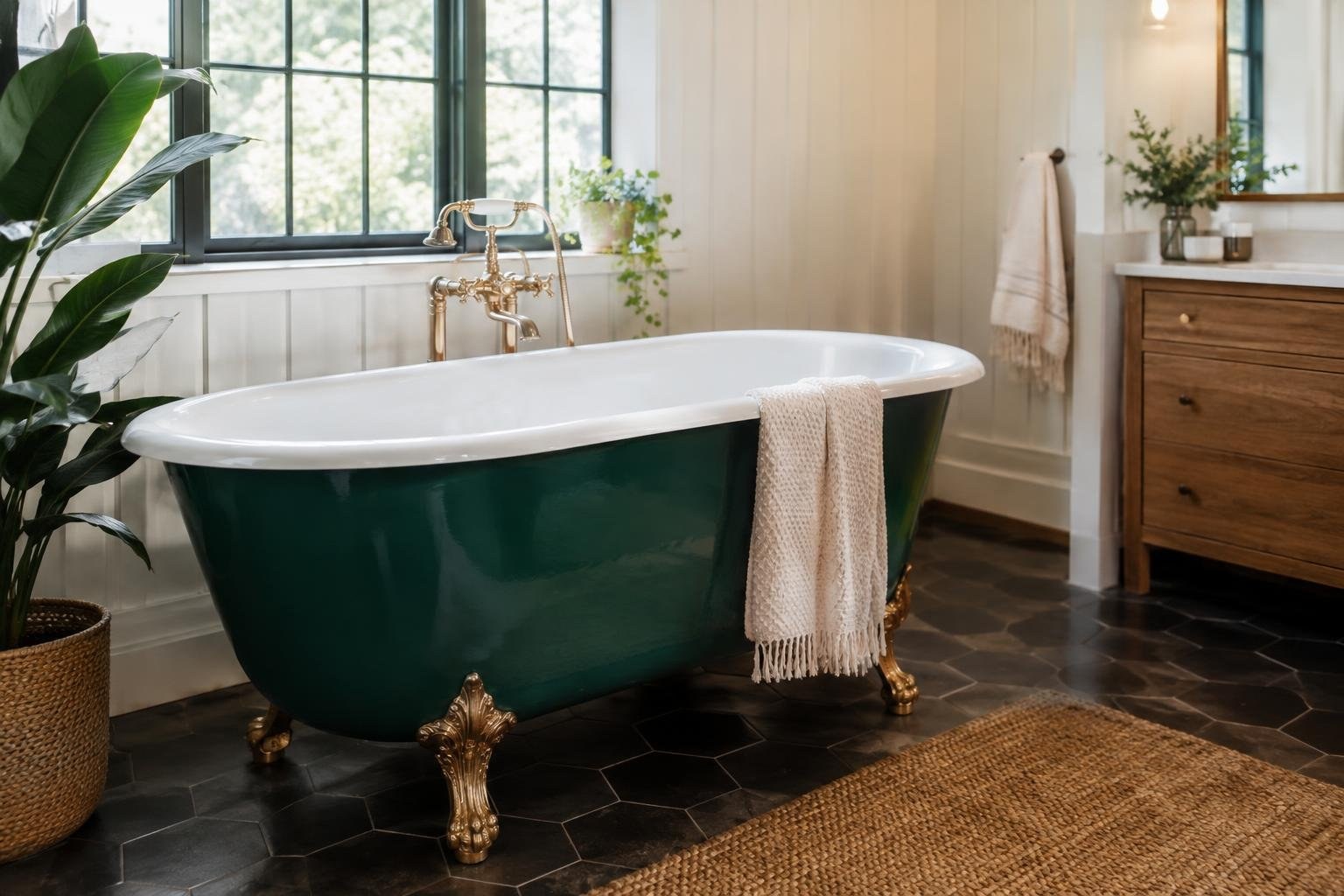
Color offers another design choice. A green clawfoot tub in a Victorian-inspired room demonstrates how a colored fixture can take center stage. A neutral tub can instead allow tile, cabinetry, or accessories to carry more of the visual interest. Before choosing, assemble samples or reference images of the major finishes and view them together. The aim is not to match everything exactly, but to make the contrast or coordination intentional.
Compare Freestanding Tub Design Options
Use this comparison as a visual starting point, not as a product specification. The table does not compare prices, lifespans, or material performance. Confirm those details for the exact tub models under consideration.
| Direction | Visual effect | Consider it when | Planning question |
|---|---|---|---|
| Clawfoot or traditional | Distinctive, vintage-inspired focal point | You want the tub to contribute character | Will its feet and finish work with the room’s other details? |
| Contemporary | A cleaner, more sculptural look | You want the tub to sit comfortably in a modern scheme | Do the tub and surrounding lines feel consistent? |
| Compact soaking form | A tub-focused idea for a tighter layout | You are exploring a smaller-room arrangement | Does the specific product fit without compromising the room plan? |
| Colorful statement tub | A strong accent and focal point | You want color to lead the design | Which finishes will balance or complement the tub? |
Compare actual dimensions, product documentation, finish choices, and installation scope before deciding. The labels above describe design direction; they do not guarantee that a particular model fits your bathroom.
When to Consider a Tub Change
A bathtub project may be worth evaluating when an existing tub no longer supports the renovation you want, or when you are redesigning the bathroom and want a different focal point. The presence of an older tub alone does not establish that replacement is necessary. If the goal is primarily visual, compare a tub replacement with other ways to refresh the room before committing to wider work.
Ask providers to inspect the current conditions and explain what work is actually needed. Clarify whether the proposal is for a fixture change, a broader bathroom renovation, or both. If the existing tub is usable and the desired improvement is mostly decorative, consider whether updates to paint, lighting, accessories, or nearby finishes could meet your priorities. Treat recurring leaks, damage, or other concerns as issues for a qualified professional to assess rather than assuming a new tub will resolve them.
Freestanding Bathtub Cost and Estimate Factors
Freestanding bathtub project prices depend on the specific tub and the work included, so compare estimates that describe the same scope. Ask each provider to separate the tub, delivery, removal, plumbing work, preparation, finish repairs, labor, cleanup, and any related bathroom upgrades where applicable.
Questions that clarify the price
- Which exact tub model and finish are included?
- Is delivery to the home and bathroom included?
- What removal and disposal work is part of the estimate?
- What plumbing changes are anticipated, and what is excluded?
- Are floor, wall, or finish repairs included if needed?
- How will concealed or unexpected work be priced and approved?
- What deposit, progress payments, and final payment are due?
Factors that can change the proposal include product selection, delivery and access, the existing bathroom condition, plumbing scope, finish choices, and how much of the room is being remodeled. Request a site visit and an itemized written quote. If comparing totals, check that the bids cover the same tasks and exclusions.
What to Expect During the Project
Installation is a coordinated project rather than a tub purchase alone. A useful planning sequence is to choose a design direction, measure and confirm the product, review the existing room, define the contractor’s scope, schedule the work, and inspect the finished result. The exact sequence and duration depend on what the renovation includes, so ask providers for a project-specific schedule rather than assuming a standard timeline.
- Plan: Choose a preferred style, gather room measurements, and note the finishes you want to retain or change.
- Verify: Ask the provider to confirm product dimensions, delivery access, plumbing needs, and the proposed location.
- Scope: Put removal, preparation, installation, finish work, cleanup, and exclusions in writing.
- Schedule: Confirm the anticipated start, work sequence, dependencies, and how changes will be communicated.
- Review: Walk through the completed work with the provider and keep product and warranty documents.
Before ordering, resolve open questions about fit and scope. A clear plan makes it easier to compare providers and discuss changes before they affect the project.
Materials, Product Details and Quality Checks
Product materials, prices, lifespans, maintenance needs, and performance are model-specific. Compare the manufacturer’s information for each model instead of assuming that two tubs with a similar shape have the same characteristics.
Ask for the exact product name and written documentation. Check the listed dimensions, finish options, care instructions, warranty terms, and any installation details the manufacturer provides. Ask the contractor to explain how the selected product affects delivery and installation. If you are choosing between models, compare those records side by side and resolve differences before purchase.
Also consider the whole-room palette. A tub can coordinate with tile and cabinetry or deliberately provide contrast. Inspiration examples include neutral bathroom schemes and a colorful clawfoot focal point. Select the finish in relation to the actual room materials, not just a screen image.
Contractors, Permits, Safety and Warranties
Contact qualified bathroom or plumbing professionals when a planned tub change involves plumbing, removal, or work whose scope you cannot verify. Ask each provider which parts of the job they will perform and who is responsible for any subcontracted work. Confirm relevant licensing and insurance with the provider and the appropriate local authority. Permit and inspection requirements vary by location and by the work proposed, so ask the local building department whether they apply.
Request a written contract that identifies the product, scope, schedule, payment terms, change-order process, cleanup, and warranty responsibilities. Ask for proof of insurance and any applicable credentials, and verify them rather than relying on a verbal assurance. Get the manufacturer’s product warranty and the contractor’s labor or workmanship terms in writing. Clarify exclusions, registration steps, and who to contact if a problem appears.
Do not approve plumbing or other renovation work based only on a tub photograph or a general promise that installation is straightforward. Have the provider explain the project-specific requirements and any unresolved conditions before work begins.
Ways to Control Cost Without Cutting Corners
To reduce avoidable expense, decide early which parts of the bathroom must change and which can stay. Choose a design direction before requesting final bids, provide consistent room information to each provider, and compare itemized estimates. Ask whether the proposed scope includes only the tub or also surrounding finishes and other work. Avoid selecting a model until the provider has reviewed its dimensions and installation requirements for your project.
Do not try to save money by skipping needed assessments, permits where required, written terms, or qualified installation. Nor should you assume the lowest bid is the best value if it omits delivery, removal, preparation, finish work, or warranty details. Ask about lower-cost product alternatives that preserve the layout and explain the tradeoffs in writing. Any proposed savings should be compared against the specific product information and work scope, not broad claims.
Coordinate the Tub With the Rest of the Bathroom
Freestanding tubs are often presented as focal points, but a successful room needs a complete composition. Consider tile, wall color, cabinetry, countertops, sinks, fixtures, storage, and accessories alongside the tub. Inspiration examples show a tub with shaker cabinetry and marble counters, as well as contemporary rooms with different cabinet and surface combinations.
Evaluate related work before finalizing the tub location. If you plan to change tile, cabinetry, or other finishes, ask providers whether those tasks should be coordinated in one renovation scope and what sequence they recommend. Combining work may affect scheduling and disruption, but whether it saves money depends on the specific bids; ask for separate and combined pricing instead of assuming a discount.
Practical finishing details help a room feel considered. A ledge near the tub can be useful for placing items, while bath mats, towels, plants, framed prints, mirrors, and other decor can add color or texture. Check that any accessory fits the layout and does not interfere with use or upkeep.
Small-Room and Larger-Bathroom Ideas
Small bathrooms can still provide inspiration for a freestanding tub, including narrow soaking forms. That does not mean every compact room can accommodate every model. Verify the product’s measurements and proposed placement with a provider, and evaluate how the tub relates to the surrounding fixtures and the room’s overall composition.
In a larger bathroom, a freestanding tub may read as a centerpiece within a broader layout. The design still needs coordination: one example pairs a tub with gray tile, cabinetry, and countertop choices, while other rooms use different styles and surfaces. Consider how the tub looks from the entrance and how the rest of the room supports it.
In any size room, compare at least two layout sketches or product options. A visual example can help describe the result you want, but measurements and professional confirmation should guide the final selection.
Common Mistakes and a Final Planning Checklist
Common planning mistakes include:
- Choosing a tub from a photograph without checking its measurements.
- Focusing on the fixture while ignoring the surrounding bathroom palette.
- Ordering before a provider reviews delivery access and the proposed location.
- Comparing estimates with different inclusions or exclusions.
- Assuming a project has a fixed cost or schedule without a site-specific quote.
- Accepting verbal descriptions instead of a written project scope.
- Leaving plumbing, permits, and inspection questions until work is underway.
- Assuming a particular product material or warranty is suitable without reading its documentation.
- Choosing the lowest bid without checking what work it leaves out.
- Forgetting to plan storage, towels, accessories, or nearby finishes.
Before committing, have the product, dimensions, installation scope, schedule, payment plan, warranty terms, and any local requirements documented. Resolve unanswered questions before approving the order or starting work.
Frequently asked questions
Are freestanding bathtubs a good idea for a bathroom renovation?
A freestanding tub can create a focal point and suit traditional, contemporary, or eclectic bathroom designs. Whether it is right for your renovation depends on the room layout, the look you want, how you plan to use the tub, and the installation requirements. Compare the complete project scope, not just the tub’s appearance.
How do I choose the right size freestanding bathtub?
Measure the proposed location and the route the tub must travel to reach it. Check the tub’s outside dimensions and shape against the available space, then account for how people will move around it and how the surrounding design will work. Ask the provider to confirm the fit and installation requirements before ordering.
What affects the cost of installing a freestanding tub?
The total depends on the tub and the renovation work included. A quote may need to account for the fixture, delivery, plumbing changes, removal of existing materials, floor or wall repairs, finishes, and labor.
What styles of freestanding bathtubs can I choose from?
Freestanding tubs are shown in traditional, contemporary, and other bathroom styles. Clawfoot silhouettes and colored tubs can make a room feel more distinctive, while a simpler shape can complement a restrained design. Compare the tub with the room’s cabinetry, tile, surfaces, and fixtures rather than choosing it in isolation.
Can a freestanding tub work in a small bathroom?
A compact freestanding tub may be possible in a smaller bathroom, but the proposed layout still needs to be checked against the tub’s dimensions and the room’s circulation. Inspiration examples show narrow soaking tubs in compact settings; use them as a starting point, then confirm the specific product and layout with a qualified provider.
How long does a freestanding bathtub installation take?
The tub’s exact model, delivery, site preparation, plumbing work, and other renovation tasks affect the schedule. Ask the contractor for a written sequence with expected start and finish dates, dependencies, and a plan for handling concealed conditions. Get timing estimates for your specific project rather than relying on a generic duration.
Does a freestanding bathtub need special plumbing?
A freestanding tub does not automatically remove the need to assess plumbing or the surrounding finishes. Before buying, ask a qualified provider to confirm the drain and supply arrangements for the selected model, identify any proposed changes, and explain whether local permits or inspections apply to the work.
How do I compare contractors for a freestanding bathtub project?
Compare quotes that describe the same tub, preparation, plumbing scope, finish work, cleanup, and warranty terms. Check relevant licensing and insurance, ask who will perform the work, and get the schedule and payment terms in writing. A low total is not useful for comparison if it omits essential work.
People Also Ask
What should you check when planning a freestanding bathtub layout?
Measure the available floor area and note existing fixtures, doors, windows, and the proposed tub position. Compare the tub’s exact dimensions with the walking route, nearby fixtures, and delivery access. Ask a provider to confirm the layout before purchase.
Are clawfoot tubs still a good choice for a renovation?
A clawfoot style can bring a traditional or vintage character, while contemporary silhouettes can suit a more modern scheme. Look at the tub’s shape, feet, finish, and visual weight alongside the room’s cabinetry and surfaces. Style alone does not confirm fit or installation requirements.
What colors go well with a freestanding bathtub?
A tub can coordinate with the vanity, tile, wall color, counters, and fixtures, or stand out as a deliberate contrast. Choose a few finishes and colors as a palette before purchasing. Inspiration galleries show both coordinated neutral rooms and colorful tubs used as statement pieces.
Where should a freestanding bathtub go in a bathroom?
A freestanding tub can sit within a larger bathroom composition rather than being treated as an isolated object. Consider the view from the doorway, the nearby vanity, and how accessories and storage will fit. Keep a clear plan for the room’s overall look before finalizing the tub position.
What should be included in a freestanding tub installation estimate?
A bathtub renovation may involve more than selecting the fixture. Ask providers to clarify delivery, removal, plumbing, preparation, finishing work, cleanup, and any related changes in their written scope. The precise work and timing depend on the selected tub and the existing bathroom.
Can a freestanding bathtub be a different color?
Yes. A freestanding tub can be a visual focal point, and a colorful finish can make that role more pronounced. Balance a strong tub color with the room’s other surfaces and accessories so that the design feels deliberate rather than accidental.
A freestanding bathtub can anchor a bathroom renovation, but the strongest design is one that fits the room, supports how you plan to use the tub, and works with the rest of the bathroom. Compare silhouettes, finishes, colors, and placement before settling on a style. Then confirm dimensions, plumbing needs, installation scope, and total project price with qualified local providers.
Your next step
Explore your options and find providers at Estimate.org.
Reviewed and maintained by the Staff at Estimate.org.
Last reviewed and updated November 2, 2026 by the Estimate.org Editorial Team.
Sources
- 75 Traditional Freestanding Bathtub Ideas You'll Love – March, 2026 | Houzz
- 47+ Freestanding Bathtub ( EYE-CATCHING CENTERPIECE ) – Bathtubs
- Freestanding Bathtubs
- 5 Best Freestanding Bathtub Ideas for a Stylish Upgrade – Wineteer Construction
- Bathroom Remodel with Freestanding Tub | The DIY Playbook
- Bathroom Renovation Ideas: How to Create a Modern and Stylish Space with a Freestanding Tub
- 10 Freestanding Bathtub Ideas That’ll Have You Dreaming in Bubbles
- 75 Freestanding Bathtub Ideas You'll Love – September, 2026 | Houzz
- Freestanding Bathtub Cost: Renovation Prices, Options, and Planning
