

Shower installation costs can range from a few thousand dollars for some conversions or prefabricated installations to substantially more for a high-end custom shower. The final price depends on what is being replaced, the shower’s size and materials, labor, plumbing changes, local requirements, and whether the work reveals a problem that was not visible beforehand. Published U.S. estimates vary: one puts a full shower remodel at $3,100 to $10,000, while another lists high-end custom showers at $14,000 to $20,000 or more. Those figures describe different scopes, so they are useful for early planning, not a substitute for local written estimates. Before choosing a design, decide whether you want a like-for-like replacement or a larger bathroom renovation. Then ask providers to price the same work, identify exclusions, and explain how changes will be approved. That approach makes the numbers more meaningful and helps prevent a low headline price from hiding work you expected to be included.
What Does Shower Installation Include?
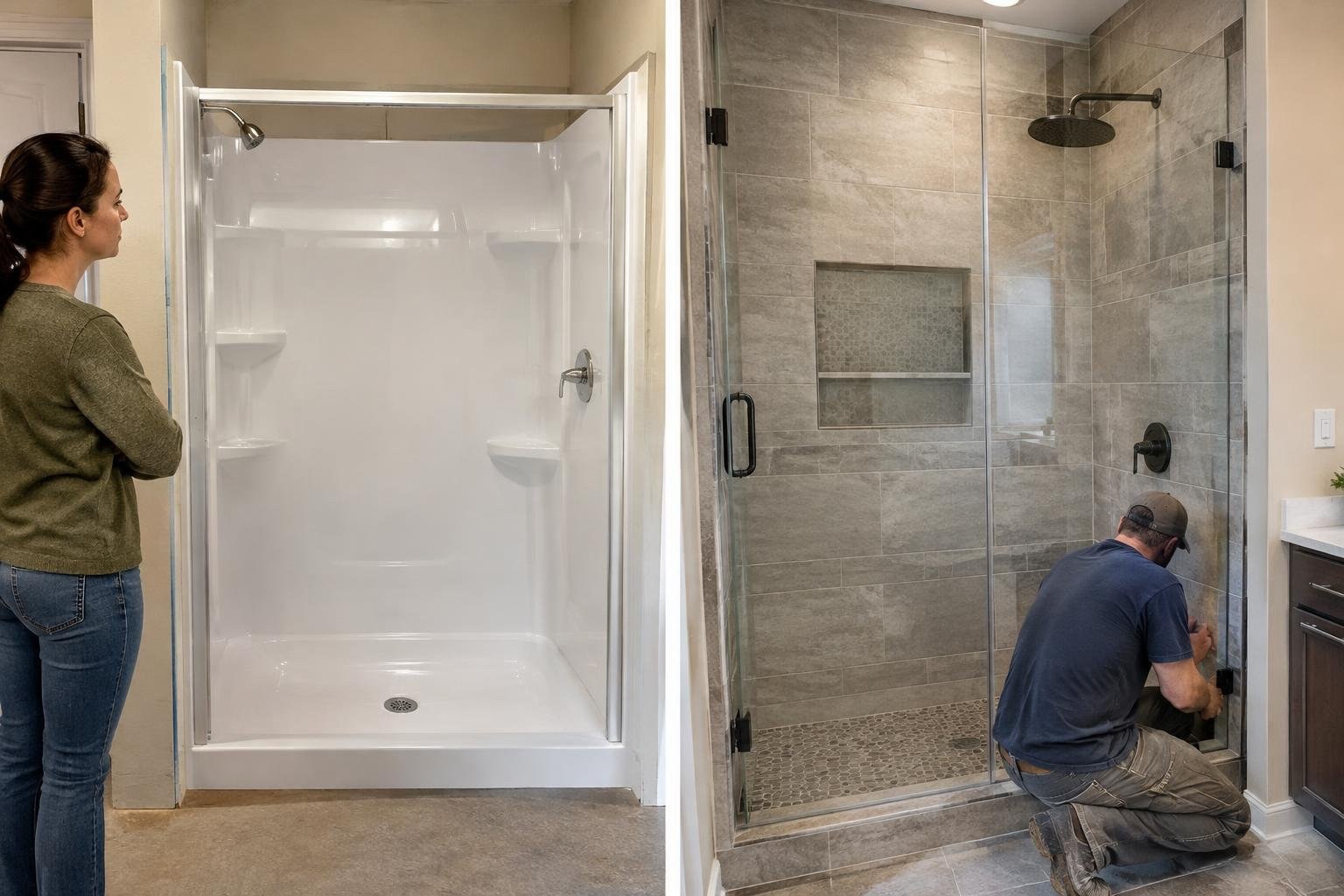
A shower project can mean replacing an existing unit, converting a bathtub to a shower, or rebuilding the shower as part of a bathroom renovation. The work may include removing existing finishes, preparing the area, installing a base or pan and wall system, connecting fixtures, and finishing surrounding surfaces. The contract should say exactly which of these tasks are included.
The distinction matters when comparing prices. A product-only price is not the same as an installed project, and a shower remodel may include different work from a simple replacement. Ask providers to describe the finished result and scope in writing.
When Should You Consider Shower Work?
Replacing a shower is worth considering when you have decided the existing unit no longer meets your needs, are planning a broader bathroom renovation, or want to change the bathing layout. First establish whether the project is cosmetic or whether it includes changing plumbing, moving the shower, or opening surrounding walls. Those choices can change the estimate substantially.
Before committing to replacement, ask a qualified provider to inspect the existing installation and explain whether a repair is a reasonable alternative. Do not assume that a surface mark or a dated finish alone means the entire shower needs replacement. Have the cause and available options documented.
Shower Installation Cost: Published Estimates and Budgeting
Published price references cover different scopes, so there is no single cost that applies to every bathroom. Modernize estimates a full shower remodel at $3,100 to $10,000, with a national average around $6,000 to $7,500. This Old House lists prefabricated walk-in showers at $4,000 to $7,000 installed and high-end custom showers at $14,000 to $20,000 or more. These are source-specific estimates, not a guaranteed local quote.
Other published figures illustrate why scope matters: a shower conversion is estimated at $1,200 to $8,000 or more, while a corner shower installation estimate is around $8,000 to $12,000. Permit estimates range from $50 to $1,000 depending on the work and local requirements; removal of an existing shower or tub is estimated at about $50 to $100 on average in one source. Confirm what each figure includes and check current local pricing before budgeting.
Request an itemized estimate that identifies materials, labor, removal and disposal, plumbing, permits, preparation, and finish work. If the provider uses allowances, ask what selections and quantities they assume. Compare total project scope, not isolated line items.
Factors That Affect the Shower Installation Project
Materials and labor: The selected shower system, wall and floor finishes, fixtures, and installation method influence the scope. In its 2026 survey, This Old House reports that 74% of respondents who completed a shower remodel identified materials as a major cost driver and the biggest influence on total project price. The survey also reports that labor commonly accounts for 40% to 60% of a shower remodel total, particularly with custom tile and plumbing work. Treat these as that publisher’s survey findings, not fixed figures for every job.
Layout and plumbing: Keeping the new shower in the existing location may involve a different scope from moving it or changing its dimensions. Ask the provider to identify any plumbing changes in the bid.
Removal, permits, and site conditions: Demolition, disposal, permit fees, and preparation may be separate line items. Ask how the provider will price additional work if removal exposes an issue that was not visible during the estimate.
Customization and location: A custom design, project complexity, access to the work area, and local labor costs can affect the total. For a tub-to-shower conversion, key cost factors include shower size, materials, shower type, plumbing work, and local labor costs. Ask for a site visit and a written explanation of assumptions rather than relying on a calculator alone.
Prefabricated, Custom, or Tub-to-Shower Conversion?
| Option | Potential fit | Budget consideration |
|---|---|---|
| Prefabricated shower | A homeowner considering a more standardized shower system | One published installed estimate is $4,000 to $7,000 for prefabricated walk-in showers; the actual scope and site conditions matter. |
| Custom shower | A renovation with a tailored design or finish selections | High-end custom showers are estimated at $14,000 to $20,000 or more by one source. Tile and plumbing work can add labor. |
| Bathtub-to-shower conversion | A project that changes an existing tub area into a shower | One published estimate is $1,200 to $8,000 or more. Cost depends on shower size, materials, shower type, plumbing work, and local labor. |
These categories are not interchangeable quotes. A conversion may have a different scope from a full remodel, and “prefabricated” does not guarantee that a project is simple or inexpensive. Ask each provider to price the same footprint, components, finishes, and included work.
How to Compare Shower Materials and Designs
Before comparing products, list what matters most in the finished shower: the footprint, entry style, surfaces, fixtures, ease of cleaning, and how the design fits the rest of the bathroom. Then ask providers to explain the material and installation choices included in their estimate.
A prefabricated system and a custom tiled shower differ in design flexibility and the work involved. This Old House estimates high-end custom showers at $14,000 to $20,000 or more and reports that custom tile and plumbing work can be labor-intensive. Do not select on the material name alone: confirm the full installed scope, care guidance, and product warranty for the specific system being offered.
When a bathroom renovation includes other finishes, coordinate selections before installation. Changing a design after materials have been ordered or work has begun can require a revised estimate and schedule. Keep product names, finish selections, and any approved changes in writing.
What to Expect During the Project
Ask providers to outline the work in stages: assessment and estimate, product selection, any required permit steps, protection and preparation, removal, installation, testing, cleanup, and final review. The exact sequence and duration depend on the scope and the contractor’s schedule, so a universal timeline would be misleading.
Get an expected start date, an estimated completion window, and a description of events that could change it. Ask when the shower will be unavailable, how the work area will be separated from the rest of the home, and who will contact you if concealed conditions require additional work. Any change should be approved and priced in writing before the work proceeds.
Preparation, Removal, and Final Walkthrough
A shower project may require removal of the existing shower or bathtub, with one published estimate putting that work at about $50 to $100 on average. That figure may not cover every demolition condition or disposal arrangement. Ask whether removal and disposal are separate charges and whether the estimate includes protection for the surrounding bathroom.
Before work, move personal items and agree on access, work hours, and cleanup responsibilities. Confirm how the provider will communicate about schedule changes and how unexpected work will be documented. At completion, review the agreed scope and ask for product and workmanship warranty information and any care instructions relevant to the installed system.
How to Choose a Qualified Shower Installer
Compare providers on more than the bottom line. Check applicable licensing requirements with your state or local authority, request proof of insurance, and ask who will perform the work, including plumbing tasks. Look for relevant experience with the shower type and project scope you want, and ask for references from comparable jobs.
Get a written estimate and contract that identify the products, labor, removal, permits, exclusions, payment milestones, schedule, change-order process, cleanup, and warranty. Ask who is responsible for permit applications and inspections if required. Avoid relying on a verbal promise when a detail could affect price, timing, or the finished work.
Consider comparing at least two or three bids, provided they use comparable materials and scope. A substantially lower bid deserves questions: it may omit preparation, disposal, permits, or finish work rather than represent an equivalent project at a better price.
Questions to Ask Before Hiring
- What work is included from removal through cleanup?
- Which products and materials are included, and what selections remain open?
- Will the shower stay in the same location, and does the estimate include plumbing changes?
- Who will do the installation and any plumbing work?
- What licenses or registrations apply to this work in my area?
- Can you provide proof of insurance and references for similar projects?
- Who checks permit requirements and obtains any required permits?
- What is excluded from the estimate, and how are allowances calculated?
- How will unexpected conditions or added work be priced and approved?
- What is the expected schedule, and what could change it?
- What product and workmanship warranties apply?
- What payment schedule do you require, and what work triggers each payment?
- How will the work area be protected, and what cleanup is included?
Permits, Credentials, Safety, and Warranties
Permit rules depend on the project and local jurisdiction. Published permit estimates range widely, from $50 to $1,000, because the amount of work and local requirements differ. That range should not be used to infer what your building department will require or charge. Contact the local authority and have the contractor clarify permit responsibility in the contract.
Ask whether inspections apply and who will arrange them. Confirm applicable licensing rules for the trades involved, verify insurance directly, and get warranty documents in writing. Read the terms for exclusions, required maintenance, registration, and the process for making a claim. Do not assume a product warranty covers installation labor or workmanship.
Ways to Control Costs Without Cutting Corners
There is no reliable savings shortcut that works for every shower. You can make estimates easier to compare by settling on a footprint, design direction, and material tier before asking providers to bid. Keeping the requested scope consistent helps show where providers differ in labor, products, and included services.
Ask whether retaining the existing layout is a practical option, and request separate prices for optional upgrades. Decide which features are priorities and which can be deferred. Do not save by skipping required permits, choosing an unqualified installer, or accepting vague promises about waterproofing, materials, or added work. A low initial number is not a useful saving if important work is excluded.
Check whether any quoted permit, removal, disposal, or plumbing charge is included in the total. The published cost ranges show that project type and scope can change the estimate significantly, so compare full written proposals before choosing.
Common Shower Renovation Mistakes
- Choosing a provider based on the total price without checking what is included.
- Comparing a product-only price with a full installation estimate.
- Assuming a prefabricated system always means a simple replacement.
- Changing the shower footprint before confirming the plumbing and project implications.
- Leaving removal, disposal, permits, or finish work out of the budget.
- Accepting an allowance without asking which product or quantity it covers.
- Relying on verbal promises instead of a written scope and change-order process.
- Failing to verify applicable credentials and insurance.
- Skipping the local permit check because a contractor says it is unnecessary.
- Paying without understanding the schedule, payment milestones, and warranty terms.
Use a written checklist to compare bids and note any unanswered questions. Resolve differences before signing rather than assuming they will be handled later.
Related Bathroom Projects to Coordinate
A shower renovation may be part of a larger bathroom project involving other fixtures, surfaces, or plumbing. If you are considering additional work, ask providers to identify which tasks affect the shower installation and which can be planned separately. Coordinating scope and finish selections before work begins can help avoid conflicting assumptions between trades.
Ask whether combining work changes the estimate, schedule, or access needs. Do not assume bundling automatically lowers the cost; request separate prices for the shower and related work so you can evaluate the tradeoff. Confirm which work should happen first with the providers responsible for the affected surfaces or connections.
For broader planning or to compare providers, explore service providers at Estimate.org.
Is Shower Installation Worth the Cost?
A shower renovation can be worthwhile when the existing setup no longer suits your needs or the shower is part of a planned bathroom update. Whether replacement is better than repair depends on the condition, desired changes, and the cost of each option. Request a diagnosis and compare written repair and replacement estimates before deciding.
Balance the initial cost against the value you place on the new layout, finishes, or improved function. A custom design can raise the project budget, while a narrower scope may make a different option feasible. Published price estimates vary widely by project type, so neither a national average nor a high-end range can establish whether your particular project is worth doing.
Shower Project Checklist
- Write down why you want to repair, replace, or convert the shower.
- Ask a provider to assess the existing setup and explain practical options.
- Choose a preliminary footprint, design, and material level.
- Get written estimates with matching scopes and clearly stated exclusions.
- Budget for labor, materials, removal, disposal, permits, and possible added work.
- Verify applicable credentials, insurance, references, and permit responsibility.
- Review the schedule, payment terms, change-order process, and warranties.
- Coordinate any related bathroom work and confirm the installation sequence.
- Before final payment, review the completed scope and request care and warranty documents.
When you are ready to compare providers, explore your options and find providers at Estimate.org.
Frequently asked questions
How much does shower installation cost?
Published estimates differ because they may describe different project scopes. One source puts a full shower remodel at $3,100 to $10,000, with an estimated national average of $6,000 to $7,500. Another estimates prefabricated walk-in showers at $4,000 to $7,000 installed and high-end custom showers at $14,000 to $20,000 or more. Treat these as planning references, not a quote for your bathroom.
Is a prefabricated shower cheaper than a custom shower?
Not always. A prefabricated shower may simplify the selection and installation process, but the total still depends on demolition, site conditions, labor, plumbing, and the scope of the work. A custom shower can cost substantially more, especially when the design uses extensive tile or requires plumbing changes. Ask contractors to price comparable scopes and materials.
How long does it take to install a shower?
Installation time depends on the project scope and contractor’s schedule. Ask each contractor for a written schedule that separates demolition, preparation, installation, inspections if required, and completion. The schedule may change if the scope expands or concealed damage is found. Confirm how the bathroom will be protected and whether the shower will be unusable during the work.
What is included in a shower installation?
A shower replacement can involve more than setting a new unit. Discuss removal, disposal, preparation, the shower base and walls, plumbing connections, fixtures, waterproofing details, finish work, and cleanup. Ask the provider to state which items are included and which are allowances or exclusions, so bids can be compared fairly.
Do I need a permit to install a shower?
It depends on the work and your local rules. Permit requirements vary by jurisdiction and by project scope. One published estimate places shower-installation permits between $50 and $1,000, depending on the amount of work and state or local requirements. Contact your local building department to confirm what applies before work begins.
How do I choose a shower installation contractor?
Ask for a line-item written estimate, proof of applicable license and insurance, references for similar projects, a defined payment schedule, and a clear workmanship warranty. Confirm who obtains permits, who performs plumbing work, how changes are approved, what happens if hidden damage is found, and how the work area will be protected and cleaned.
What can make a shower remodel more expensive?
Potential additions include changes to plumbing, a different shower footprint, custom finishes, permit fees, removal and disposal, and repairs discovered after the existing shower is opened. Estimates for full remodels and conversions show broad ranges, which is one reason to request an on-site assessment and have exclusions documented before comparing totals.
How can I save money on a shower renovation?
Compare the full installed scope, not only the price of the shower unit. Check whether demolition, disposal, preparation, materials, labor, plumbing, permits, and finish work are included. Published estimates range from lower-priced conversions to high-end custom work, so a low total may reflect a smaller scope rather than better value.
What does it cost to convert a bathtub to a shower?
A shower conversion means changing the existing bathing setup, such as replacing a tub with a shower. A published estimate gives a broad conversion range of $1,200 to $8,000 or more, depending on size, materials, shower type, plumbing work, and local labor costs. Confirm the exact scope and local pricing before using that range to budget.
Should I repair or replace my shower?
Repair may be worth pricing when the problem is limited and the surrounding shower is otherwise suitable. Replacement may be more practical when the existing unit or finish is beyond repair or the renovation plan changes the layout. Get a diagnosis first, and compare repair and replacement estimates with the same assumptions about materials, labor, and any additional work.
People Also Ask
How do I compare shower installation estimates?
Ask providers to price the same footprint, components, finishes, and included work. Compare itemized totals for materials, labor, removal and disposal, plumbing, permits, preparation, and finish work, and clarify any allowances or exclusions.
What work should a tub-to-shower conversion estimate include?
Ask the provider to specify removal, the shower size and system, materials, plumbing work, labor, finishes, and any permit-related responsibilities. A published conversion estimate is $1,200 to $8,000 or more, but the exact scope and local pricing should be confirmed in writing.
What affects the installed cost of a prefabricated shower?
The total can depend on demolition, site conditions, labor, plumbing, and the project scope, not just the shower unit. One published estimate for installed prefabricated walk-in showers is $4,000 to $7,000; compare the full installed scope with local written bids.
How much does a shower permit cost?
Published permit estimates range from $50 to $1,000, but the actual requirement and fee depend on your jurisdiction and the work planned. Ask your building department which permits and inspections apply to your project.
What should I do if demolition reveals a hidden problem?
Ask the provider to explain the issue, document the proposed additional work and its cost, and state how it affects the schedule. Have changes priced and approved in writing before the added work proceeds.
How should I evaluate an allowance in a shower estimate?
Ask which product selections and quantities the allowance assumes, and whether the amount covers materials, labor, or both. Compare those assumptions across bids and get any selection-related price changes documented.
Shower installation cost depends less on the word “shower” than on the scope: a straightforward replacement in the same footprint is different from a custom rebuild involving new plumbing, tile, or repairs behind the walls. Compare estimates that describe the same work, confirm what is excluded, and verify permits and contractor credentials before signing. When you are ready, explore your options and find providers at Estimate.org.
Your next step
Explore your options and find providers at Estimate.org.
Reviewed and maintained by the Staff at Estimate.org.
Last reviewed and updated November 2, 2026 by the Estimate.org Editorial Team.
Sources
- How Much Does a Walk-In Shower Cost? (2026 Pricing)
- How Much Does Shower Installation Cost? – Forbes Home
- Shower Installation Cost in 2026 – Walk-In, Alcove & Custom Shower Price Breakdown
- How Much Does a Shower Remodel Cost? (2026 Pricing)
- Shower Remodel Cost Calculator: Estimate How Much You'll Pay
- How Much Does it Cost to Install a Shower in 2026?
- Shower Replacement Cost: What to Budget for a Bathroom Renovation
- Walk-In Shower Cost: Renovation Prices, Options, and Planning
